At The Berkeley Palm Beach, a bespoke interior should begin with a careful reading of condominium ownership rights. Contractor access, alteration approvals and building logistics are questions to resolve before closing, not freedoms to assume afterward.

A beautifully tailored residence begins with a clear understanding of what its owner can change. At The Berkeley Palm Beach, that distinction matters before a designer develops drawings or a specialist fabricator receives a deposit. The question is not simply whether an interior can be personalized, but under what conditions the work can proceed after closing.
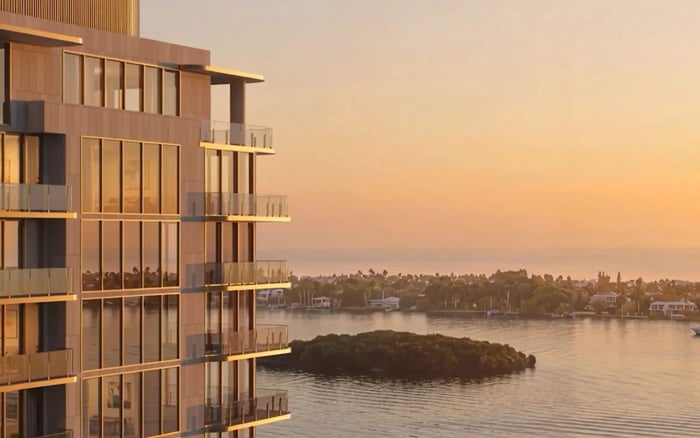
As of July 7, 2026, the development was planned as a 25-story condominium with 193 residences at 550 South Australian Avenue in West Palm Beach, not the Town of Palm Beach. Plans call for two- to five-bedroom floor plans overlooking Clear Lake and the city skyline. Those characteristics define the residential setting; they do not establish an owner's renovation rights.
The complications discussed here are potential planning risks, not confirmed restrictions at The Berkeley. Confirm contractor-access requirements and alteration procedures in the applicable documents and directly with the party responsible for administering them.
The Berkeley's architect is Arquitectonica, and its general contractor is John Moriarty & Associates. Developer Al Adelson is also known for The Bristol Palm Beach in West Palm Beach. That development background provides context, not a basis for assuming the two properties share customization policies.
Florida's Chapter 718 establishes the legal framework for condominium ownership. An owner holds an individual unit together with an undivided interest in the common elements. Purchasing a residence does not confer exclusive control over the building, its shared circulation or its systems.
For a buyer envisioning bespoke cabinetry, revised lighting or a reconfigured bathroom, the first task is to identify where the proposed work intersects with those shared interests. Review unit boundaries, maintenance responsibilities and approval provisions before treating anything behind a finished surface as exclusively yours to alter.
Florida law prohibits work within a unit or on common elements that adversely affects the safety or soundness of common elements or property maintained by the association. An elegant design therefore requires a technically sound, document-compliant scope-not merely an attractive presentation.
Association maintenance access and an owner's contractor access are distinct legal and operational questions.
An association has an irrevocable right of access during reasonable hours when necessary to maintain, repair or replace common elements or portions of a unit it maintains. That right also applies when entry is necessary to prevent damage to common elements or other units.
This statutory right does not itself establish a renovation-approval procedure or authorize an owner's preferred contractor to enter and begin work. Florida law does not specifically require an owner to supply the association with a key, but the association retains its statutory access rights. Buyers should have counsel review any document-specific access obligations rather than interpret the key issue as a general right to refuse necessary entry.
The practical distinction is straightforward: permission to own, permission to alter and permission for a particular team to access the building are not interchangeable.
A design may be acceptable in principle yet difficult to schedule in practice. Ask management whether permitted work hours, blackout dates or restrictions on noisy tasks apply. None should be assumed to be a Berkeley rule without confirmation.
Next, establish the contractor onboarding requirements. What insurance documentation is requested? Are there requirements for subcontractors, escorts or advance identification? Who reviews the submission, what makes it complete, and how are revisions handled? Request the applicable process in writing, including any stated review timelines.
Then test the logistics against the actual design. Does a stone delivery require a loading reservation? Must service-elevator time be booked separately? Are there limits on simultaneous renovation projects? Who coordinates deliveries if installation dates change? These are questions for management, not established restrictions at the property.
Consider a hypothetical custom kitchen: fabrication may be complete while delivery access remains unresolved. If reservations or limited work windows apply, the buyer could face storage expenses, rescheduling or a later installation. The risk lies in a mismatch between the supplier's calendar and the building's operating requirements, not necessarily a prohibition on the design itself.
For residential condominiums offered before construction is complete, Section 718.503 requires developers to make complete construction plans and specifications available to prospective purchasers for inspection. Developer-sale disclosures also include governing documents. Review those materials before making expensive customization commitments.
Have the design team evaluate proposed changes against the available structural, mechanical, plumbing and life-safety information. A layout that appears simple on a marketing floor plan may raise questions only the construction documents can answer. Ask which drawings govern the intended work and whether the proposed scope requires additional technical review.
For buyers also considering Alba West Palm Beach, the useful comparison lies in the documents: what each property's governing materials permit and how its approval and access procedures operate. Do not infer equivalent flexibility from a shared city address or luxury positioning.
If changes might be arranged before delivery, ask whether that option exists and how it would be documented. Do not assume a developer customization program is available or that a conversation about preferences amounts to an approved scope.
Before closing, review the declaration, bylaws and applicable alteration rules with Florida condominium counsel. Translate the design brief into specific questions: which changes need approval, who can grant it, and what evidence should the owner retain?
Separate design acceptance from contractor clearance and physical access arrangements. Ask whether an approval addresses all three or only one. A written sequence can help an owner avoid commissioning irreversible fabrication while an essential permission remains unresolved.
Closing and the transfer of association control to owners are distinct milestones. An individual purchaser should not assume that closing means owner control has begun. Identify who will administer alteration requests when the work is anticipated and ask how any governance transition could affect a pending submission.
Treat acquisition, customization and occupancy as separate planning tracks. Before committing to an arrival date, confirm the approval path, contractor requirements and delivery arrangements. Then have the design team build its schedule around those answers. Where costs depend on uncertain access, request alternative timing and pricing assumptions rather than rely on a single optimistic calendar.
For an owner seeking a highly personal residence, this discipline protects the design ambition. The objective is not unrestricted construction, but a clear route from an approved concept to a finished home within a shared building.
Explore South Florida residences with an ownership-focused perspective at MILLION.
If branded residences are on your mind — as a home or as an allocation — we would be glad to share what we are seeing, privately.
Begin a quiet conversationNo. The planned condominium is at 550 South Australian Avenue in West Palm Beach.
As of July 7, 2026, The Berkeley was planned as a 25-story condominium with 193 residences and two- to five-bedroom floor plans.
The access complications discussed are potential planning risks, not confirmed Berkeley restrictions. Buyers should confirm applicable requirements in the governing documents and with management.
No. Condominium ownership combines ownership of an individual unit with an undivided interest in common elements, subject to applicable governing documents and law.
Review the declaration, bylaws and applicable alteration rules with Florida condominium counsel. Construction plans and specifications should also inform changes involving building systems.
No. The association's right to enter for specified maintenance and damage-prevention purposes does not itself establish contractor access or renovation approval.
Florida law does not specifically require an owner to provide a key, but the association retains its statutory access rights. Counsel should review any document-specific obligations.
For residential condominiums offered before construction is complete, Section 718.503 requires developers to make complete construction plans and specifications available to prospective purchasers for inspection.
Ask about work hours, blackout dates, insurance, approval timelines, loading access, elevator reservations, escorts and simultaneous-project limits. These are questions to resolve, not confirmed Berkeley policies.
Not necessarily. Closing on an individual unit and transferring association control to owners are distinct milestones, so buyers should identify who will administer their alteration requests.