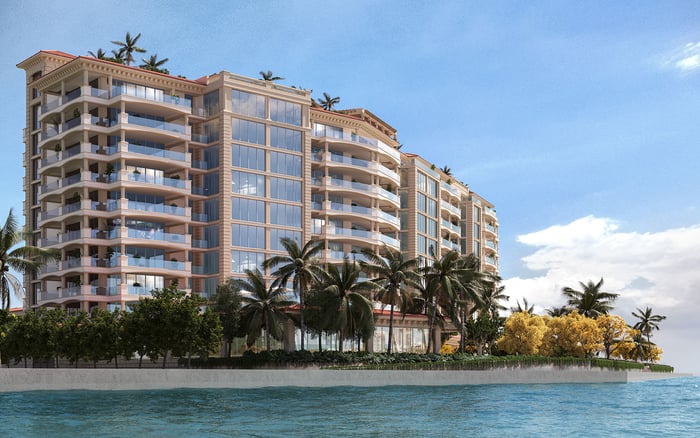
A precise framework for separating Fisher Island association charges, Club costs and optional residence services before calculating a new condo's annual carry.

For a buyer evaluating a new-construction residence on Fisher Island, annual carry is not a single line item. It is a stack of obligations involving the building association; the Fisher Island Community Association, commonly called FICA; Fisher Island Club access; and optional services within the residence. Each layer has its own billing logic, inclusions and potential for change.
That distinction matters whether the residence is intended as a primary home, a second-home retreat or part of a broader investment portfolio. A quoted monthly maintenance figure may cover only the condominium association. It may exclude island-wide dues, Club membership, housekeeping, unit management, guest charges, golf privileges and the service costs associated with an absentee-owner lifestyle.
The true annual carry is a stack of obligations, not a single maintenance number.
Fisher Island has more than 23 sub-associations, each with its own operating budget, reserves and assessments. Condominium HOA figures have ranged from approximately $12,452 to $47,000 annually, with an average near $23,470. Those broad figures offer useful context, but they cannot replace the governing documents for the specific building and residence.
Service intensity is a major variable. Newer, higher-service buildings can carry HOA charges of roughly $4,000 to $8,000 or more per month, while older villages are closer to $1,500 to $3,000 monthly. Inclusions often encompass building maintenance, groundskeeping, security, building insurance, water, sewer, trash and selected cable or internet services. The precise package varies.
A practical working benchmark is approximately $1.15 per square foot per month, including reserves. Applied to a 3,000-square-foot condominium, that equates to $3,450 per month, or $41,400 annually. It is an illustration, not a quote. Buyers comparing The Residences at Six Fisher Island with an existing residence at Palazzo del Sol should compare actual budgets, reserve schedules and service inclusions rather than apply a single island-wide rate.
FICA supports island-wide infrastructure and operations, including ferry transportation, security, roads and landscaping. Annual FICA dues are $53,378.36, an amount not included in Club annual rates.
An earlier figure framed FICA as a flat $2,800 monthly charge, sometimes translated to roughly $0.60 to $0.85 per square foot depending on residence size. That historical presentation should not be layered onto the current annual figure as though both were payable. The buyer's closing team should confirm the amount in force, billing cadence and any proration directly from the contract and estoppel documents.
Using the 3,000-square-foot illustration, the $41,400 building HOA plus $53,378.36 in FICA dues equals approximately $94,778 annually. That subtotal still excludes Club dues, property taxes, insurance gaps, utilities, housekeeping and unit management.
Fisher Island Club access is separate from the building HOA and FICA. Historical figures placed the equity contribution at $250,000, with $22,256 in annual dues. By July 2025, the figures had risen to $350,000 for equity initiation and approximately $38,000 in annual Club dues. The difference underscores why a buyer should obtain the schedule effective at contract signing.
Initiation or equity contributions belong among acquisition costs, not recurring annual carry. Annual dues belong in the carry model. Combining the illustrative $94,778 association subtotal with the separate $38,000 annual Club figure produces approximately $132,778 before optional services and other ownership expenses.
Club usage can generate additional charges. Certain membership categories have carried guest fees of about $250 per day for two guests and $100 for each additional adult. Golf privileges may require another annual fee, with greens and cart fees charged separately. None should be treated as included without written confirmation.
There is no universal Fisher Island fee schedule for unit management, housekeeping or gratuities. These services should be priced through the building, designated operator or chosen private provider. This is especially important for a waterfront home that may remain unoccupied for extended periods.
For housekeeping, request rates for each cleaning format, along with the minimum visit length, staffing level, linen handling, supplies, holiday premiums and cancellation policy. Ask whether invoices include a service charge and, if so, whether it is distributed as gratuity. Do not insert a generic resort gratuity percentage into the model without property-specific documentation.
For unit management, define the scope before accepting a monthly or annual fee. The written menu should address absentee-owner inspections, key holding, storm preparation, vendor access, minor-maintenance coordination, package handling, arrival preparation and emergency response. It should also identify pass-through expenses, after-hours rates and spending authority.
These questions apply across property types. A buyer weighing a condominium at Palazzo della Luna against a home at The Links Estates at Fisher Island should not assume that one service protocol, staffing model or gratuity convention transfers to the other.
The cleanest worksheet separates fixed recurring costs, usage-based costs and acquisition-only costs. Fixed recurring lines should include the building assessment, FICA dues, applicable Club annual dues, known insurance expenses, property taxes and contracted unit management. Usage-based lines should capture housekeeping, utilities, guest charges, food-and-beverage obligations, golf charges, repairs and vendor coordination. Initiation and equity contributions should remain outside the annual total.
Before closing, obtain the association's current budget, reserve schedule, assessment history and estoppel. Reconcile every quoted figure with the residence's allocated interest and payment schedule. Then request written fee sheets for housekeeping, inspections, key holding, maintenance coordination, service charges and gratuities. The most credible model includes a clearly labeled contingency rather than burying uncertain expenses within an optimistic estimate.
The objective is not merely to produce a larger number. It is to distinguish unavoidable obligations from elective lifestyle spending, identify which charges may change and understand the level of service the residence actually receives. On Fisher Island, that clarity is part of the luxury.
For discreet guidance on evaluating Fisher Island ownership costs and residences, connect with MILLION.
If branded residences are on your mind — as a home or as an allocation — we would be glad to share what we are seeing, privately.
Begin a quiet conversationThe principal layers are the building association, FICA, applicable Club dues, taxes, insurance, utilities and optional residence services such as housekeeping and unit management.
No. FICA is a separate island-wide obligation supporting infrastructure and common operations such as ferry transportation, security, roads and landscaping.
Current membership material lists annual FICA dues of $53,378.36 and states that they are not included in Club annual rates.
At the working benchmark of $1.15 per square foot per month, the illustration is $3,450 monthly or $41,400 annually.
Combining the $41,400 building illustration with $53,378.36 in FICA dues produces approximately $94,778 annually before Club dues and other ownership costs.
No. Club access requires separate membership and is not automatically included in either the building HOA or FICA dues.
No. An initiation or equity contribution is an upfront acquisition cost, while annual Club dues belong in the recurring carry model.
No. Buyers should obtain a written property-specific fee sheet covering cleaning formats, staffing, supplies, service charges and gratuity treatment.
It should define inspections, key holding, storm preparation, vendor access, maintenance coordination, emergency response, pass-through costs and spending authority.
Review the current budget, reserve schedule, assessment history and estoppel, then reconcile them with the residence's allocated interest and payment schedule.