At South Flagler House, disclosed association charges establish only the base layer of ownership cost. A disciplined review separates mandatory dues from optional residence management, housekeeping, gratuities, and every residence-specific expense before calculating the true annual carry.

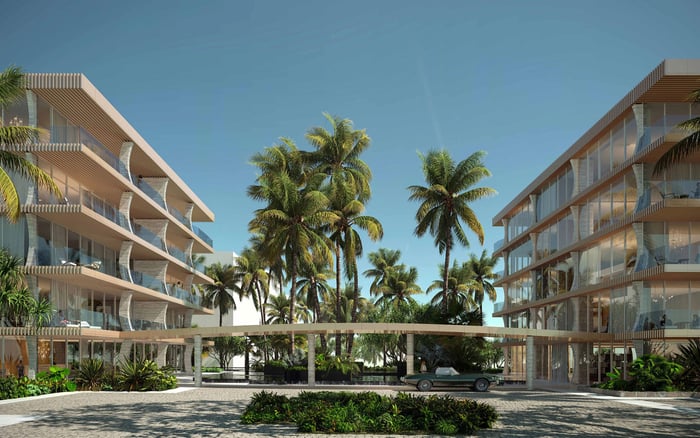
At 1355 South Flagler Drive in West Palm Beach, South Flagler House presents an ownership proposition in which service matters as much as architecture. The 28-story building comprises 105 residences, including two- to five-bedroom homes, penthouses, and guest suites. The residence count is also stated as 108 units-a discrepancy that should be reconciled against the controlling condominium documents rather than dismissed as a minor editorial difference.
The central underwriting question is not simply, “What is the HOA?” It is, “Which services are mandatory, which are elective, and which expenses remain entirely residence-specific?” Disclosed fees establish a meaningful base, but no verified separate schedule establishes the cost of unit management, housekeeping, linen service, or gratuities. Those categories belong in the diligence file as open items, not assumed amenities.
The disclosed association fee is the beginning of the annual-carry calculation, not its conclusion.
The clearest unit-level sample ranges from $5,085 to $10,745 per month. Unit 103 is listed at $5,085 monthly, or $61,020 annually. Unit 201 is listed at $6,212 monthly, or $74,544 annually. Unit 1601 is listed at $9,413 monthly, or $112,956 annually. Unit 2301 is listed at $10,195 monthly, or $122,340 annually, while Unit 1900 reaches $10,745 monthly, or $128,940 annually.
For Units 103 and 201, the stated inclusions are common areas, sewer, security, and water. That is useful, but it should not be generalized across every residence without confirmation. The observed range of $61,020 to $128,940 annually remains a base association burden before residence-specific taxes, insurance, utilities, and separately billed services.
Rate indications also vary materially. Figures include approximately $1.20, $2.12, $2.13, and $2.20 per square foot per month, while a broader monthly estimate spans $3,000 to $8,000. These numbers are not interchangeable. The decisive variables are the area definition, the residence selected, the effective budget, and the services included in each figure.
This fee dispersion is especially relevant to penthouse underwriting. Custom homes on floors 25 through 28 span approximately 9,743 to 14,053 square feet and are marketed from $49.5 million to $70 million. At that scale, even a small difference in the applicable rate or measured area can materially alter the annual plan.
A rigorous diligence model should divide ownership costs into four ledgers.
First, mandatory association charges.
Record the current monthly amount, annualize it, and identify every stated inclusion. Determine whether parking, building insurance, concierge, security, valet, water, sewer, and common-area operations are included for the specific residence. One dues description begins near $1.20 per square foot and includes building maintenance, insurance, allocated underground parking, security, concierge, and valet, but those terms should still be tested against the unit’s governing paperwork.
Second, residence-specific fixed costs.
Keep property taxes, unit insurance, utilities, and other direct ownership expenses outside the HOA line. The fee sample does not establish those amounts; populate them only with residence-specific evidence.
Third, optional operating services.
Create separate rows for unit management, housekeeping, linen service, staffing, and vendor coordination. No verified South Flagler House tariff establishes the cost of these services. Before assigning any figure, request the current menu, frequency options, minimum commitments, cancellation terms, and billing method.
Fourth, discretionary service culture.
Give gratuities their own line. Determine whether any service charge is automatic, whether gratuities are pooled, whether seasonal giving is customary, and whether outside personnel may accept tips. Until a written policy is supplied, a gratuity allowance is a personal planning assumption-not a building fee.
The most useful worksheet has three columns: verified mandatory, quoted optional, and owner-selected. Each entry should include a billing frequency, effective date, stated inclusion, and controlling document. Convert monthly numbers into annual totals, while keeping one-time deposits or setup charges separate from recurring carry.
This discipline also exposes double counting. If water is included in association dues, it should not reappear as a full standalone estimate. If a residence-management package includes vendor access or housekeeping coordination, determine whether those functions overlap with concierge services already funded through the association. Lifestyle convenience has value, but transparent accounting prevents the same convenience from being budgeted twice.
For an investment review, model at least the disclosed association charge and all known residence-level costs before adding assumptions for optional services. For a second-home owner, absence patterns may make unit oversight and housekeeping more important, but their cost still cannot be inferred from association dues. This distinction is central to branded residences, where hospitality language can blur the boundary between access to a service and its inclusion in the base fee.
A buyer considering Mandarin Oriental Residences, West Palm Beach, The Ritz-Carlton Residences® West Palm Beach, or Forté on Flagler West Palm Beach should apply the same template to each property. The purpose is not to force unlike buildings into a single price-per-square-foot contest, but to compare mandatory costs, service access, elective programs, and owner-controlled spending under consistent definitions.
Serious buyer’s guides should foreground this distinction. A lower headline fee may exclude services that another property funds collectively, while a higher fee may still leave substantial private staffing and housekeeping outside the association budget. Translate lifestyle expectations into a service calendar: arrival preparation, routine inspections, cleaning frequency, linen changes, provisioning, vendor supervision, and departure closeout. Only written quotes can convert that calendar into a defensible annual figure.
Before contract and again before closing, reconcile the offering plan, current adopted budget, association statements, unit-specific fee notice, and written schedules for elective services. Confirm the residence’s interior area, the rate applied to it, the first billing period, and any distinction between regular assessments and separately billed items. The conflicting counts of 105 and 108 residences should also be resolved in the controlling documents.
Request written housekeeping and linen pricing, the residence-management agreement if offered, and the applicable gratuity or service-charge policy. If no formal program exists, document that conclusion and obtain private vendor quotes instead. Precision here is not administrative fussiness. It is the difference between a polished acquisition narrative and a reliable ownership budget.
The prudent conclusion is concise: South Flagler House’s disclosed HOA figures provide a substantial base range, but they do not establish the true annual carry. That figure emerges only after mandatory dues are combined with verified unit expenses and consciously selected services, without treating unknown housekeeping, management, or gratuity costs as included.
For discreet guidance on South Florida’s ultra-premium residential market, connect with MILLION.
If branded residences are on your mind — as a home or as an allocation — we would be glad to share what we are seeing, privately.
Begin a quiet conversationThe sampled disclosures run from $61,020 to $128,940 annually, depending on the residence.
No. It is a base carrying cost before residence-specific taxes, insurance, utilities, and separately billed services.
No separate unit-management fee schedule is verified in the available materials. Buyers should request the current written program and pricing.
The available disclosures do not verify a housekeeping or linen-service tariff or establish that those services are included.
No project-specific gratuity policy is verified in the available materials. Buyers should ask about automatic charges, pooling, and customary seasonal giving.
Their listings identify common areas, sewer, security, and water as included items.
The figures range from about $1.20 to $2.20 monthly per square foot, potentially reflecting different area measures, residences, budgets, or inclusions.
One count gives 105 residences, while another gives 108 units. Buyers should reconcile the discrepancy through controlling documents.
Review the offering plan, adopted budget, association statements, unit-specific fee notice, and written schedules for optional services.
Place unit management, housekeeping, linen service, staffing, vendor coordination, and gratuities in separate rows supported by written quotes or policies.