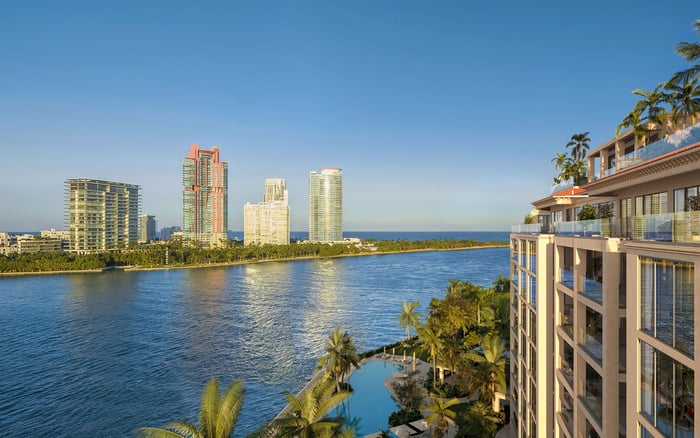
A buyer-focused look at how staff-ready service circulation shapes ultra-luxury condominium decisions at Oceana Key Biscayne, The Residences at Six Fisher Island, and Vita at Grove Isle.

For ultra-high-net-worth households, the most persuasive luxury is not always the view, the terrace, or the finish package. It is whether the residence functions gracefully when a full private ecosystem is in motion. Chefs arrive before dinner. Housekeepers reset rooms between guests. Nannies, trainers, security personnel, wellness practitioners, florists, caterers, drivers, and maintenance teams may all need to work on the same day without disturbing the calm of the home.
That is the essence of staff-ready service circulation: the back-of-house system that allows household employees, vendors, deliveries, and building personnel to move discreetly from arrival to service areas without crossing the primary owner and guest experience. In the best buildings, this is not a minor convenience. It is part of the architecture of privacy.
This is why buyers comparing Oceana Key Biscayne, The Residences at Six Fisher Island, and Vita at Grove Isle should look beyond lifestyle language and test how each property would actually perform for a staffed household. The question is practical: can the people who support the residence do their work without becoming part of the scene?
A staff-supportive condominium is not defined by a single feature. It is the combination of secondary or service elevators, service corridors, discreet loading areas, staff entries, storage, staff rooms or suites where applicable, and clear protocols for vendors and household employees. The floor plan matters, but the operating rules matter just as much.
The strongest due-diligence question is simple: can staff move from arrival or loading to the residence and appropriate service areas without using the same path as owners and guests? If that route depends on repeated use of a formal lobby, primary elevator bank, or guest-facing amenity sequence, the residence may feel less private in daily life than it appears in marketing.
Oceanfront properties can be especially seductive because the front-of-house experience is so visually powerful. Yet a beautiful arrival sequence does not answer whether groceries, flowers, linens, catering equipment, wellness gear, or maintenance teams have their own logical route. Penthouse buyers face the same issue at a larger scale, because larger residences often require more frequent staffing and more complex event preparation.
At Oceana Key Biscayne, the buyer’s analysis should begin with completed-building operations. For an existing ultra-luxury condominium, daily management practices can be as important as the original architectural intent. Buyers should verify how household staff, vendors, deliveries, and maintenance are currently handled, because lived-in protocols reveal whether a building is truly comfortable for a staffed household.
In a privacy-conscious Key Biscayne setting, that review should include service elevator access, vendor arrival procedures, loading rules, household-staff registration, delivery timing, storage options, and any restrictions that affect recurring domestic teams. The residence may be beautiful, but a buyer who entertains frequently or travels often needs to know whether the building can support preparation, cleaning, stocking, and response without visible friction.
The advantage of reviewing a completed building is that questions can be precise. A buyer can ask how a private chef enters on a busy evening, where a florist stages arrangements, how housekeepers access the residence, and how maintenance is scheduled when owners are away. These details are not glamorous, but they are decisive.
For The Residences at Six Fisher Island, the central issue is whether ultra-private positioning is matched by practical back-of-house circulation. Fisher Island buyers often prize separation, discretion, and a residential rhythm that feels closer to a private estate or private hotel than a conventional condominium. In Fisher Island conversations, service movement is not secondary to privacy. It is one of the ways privacy is delivered.
The buyer should therefore test the entire staff journey: arrival, screening, loading, elevator access, service corridor, residence entry, and any staff-supportive spaces within the home. A well-conceived service sequence should allow chefs, housekeepers, nannies, security teams, wellness staff, and vendors to perform quietly while owners and guests experience only the polished result.
This is especially important for households with multiple staffed residences across countries. If an owner expects the same standard of operational discretion in Miami as in London, New York, Monaco, or the Caribbean, the building must support routines that are repeatable, controlled, and legible to household managers.
Vita at Grove Isle belongs in this conversation because buyers considering private, service-sensitive South Florida residences often compare distinct waterfront settings, development eras, and lifestyle propositions. The appropriate lens is not whether one property uses the same operational model as another. It is whether the residence and building rules can support the buyer’s actual household pattern.
For Vita at Grove Isle, buyers should request current plans, service diagrams, delivery protocols, vendor access rules, and staff registration procedures before assuming staff-ready performance. The same discipline applies to any new or recently introduced luxury property: architectural promise should be matched by practical circulation from the point of arrival to the point of work.
Coconut Grove buyers often value a softer residential mood, but privacy remains a systems question. If the owner expects dinner preparation, wellness appointments, housekeeping, child care, and security coordination to happen in the background, the building must make that background function elegantly.
The most useful review is concrete. Buyers should request current floor plans, service-elevator diagrams, loading-dock rules, vendor access policies, household-staff registration procedures, storage details, and any rules affecting recurring staff or outside service providers. If the residence is intended for frequent entertaining, the review should also include catering access, staging options, refuse removal, guest-flow separation, and after-event reset procedures.
The household manager, private chef, or family office should be part of this review when possible. They will notice operational gaps that a buyer may not see during a polished tour. Where does staff wait? How are deliveries screened? Can a vendor arrive without disturbing the owner? What happens when two service teams arrive at once? Is there a discreet route for maintenance during a house party?
For second-home owners, the stakes are even higher. A residence that sits empty for periods must still be easy to stock, inspect, clean, secure, and prepare before arrival. Service circulation is what turns a beautiful condominium into a residence that is ready when the owner lands.
Oceana Key Biscayne, The Residences at Six Fisher Island, and Vita at Grove Isle serve the same elevated buyer need from different starting points. One buyer may favor the known operating reality of a completed building. Another may focus on the private-island promise of a new ultra-luxury environment. Another may be drawn to Grove Isle’s residential character while still requiring a serious operational plan.
The comparison should not be reduced to amenities alone. Staff-ready service circulation protects the front-of-house experience. It allows the home to be prepared, cleaned, staged, stocked, secured, and restored while owners and guests remain in a world that feels effortless. For the most discerning South Florida buyer, that is not a back-of-house detail. It is the infrastructure of ease.
What does staff-ready service circulation mean? It refers to the building systems that let staff, vendors, and maintenance teams work discreetly without crossing the owner and guest experience.
Why does this matter in ultra-luxury condos? Staffed households often operate like private hotels, with daily domestic, wellness, security, and hospitality support requiring controlled movement.
What should buyers verify first? They should confirm whether staff can move from arrival or loading to the residence without using the same path as owners and guests.
Is a service elevator enough? Not by itself. Buyers should also review corridors, loading rules, staff entries, storage, vendor protocols, and registration procedures.
How should Oceana Key Biscayne be evaluated? Buyers should focus on current building logistics, because completed-building operations often determine how well staff support works day to day.
What is the key question at The Residences at Six Fisher Island? Buyers should test whether the property’s privacy positioning is matched by dedicated service circulation from arrival to residence.
Can Vita at Grove Isle be compared on the same basis? Yes, but buyers should verify current plans, rules, service access, and operating procedures before relying on assumptions.
Who benefits most from staff-ready circulation? Owners who entertain often, travel frequently, maintain multiple homes, or rely on daily household staff benefit the most.
Should household managers join property tours? Yes. They can identify operational issues involving deliveries, staffing, staging, maintenance, and event preparation.
What is the best way to shortlist comparable options for touring? Start with location fit, delivery status, and daily lifestyle priorities, then compare stacks and elevations to validate views and privacy.
For a confidential assessment and a building-by-building shortlist, connect with MILLION.
If branded residences are on your mind — as a home or as an allocation — we would be glad to share what we are seeing, privately.
Begin a quiet conversation