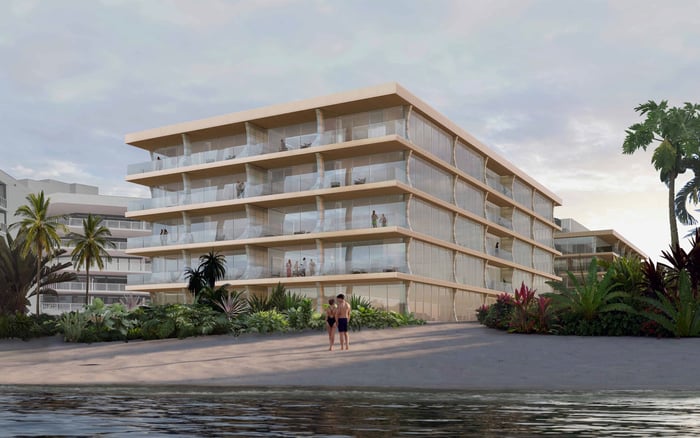
Two waterfront residential offerings sharpen the distinction between an advertised amenity and a documented right. For buyers, the essential questions concern parking control, valet responsibility and the practical allocation of EV charging.

For a buyer whose household includes several vehicles or an electric daily driver, the garage deserves the same scrutiny as the residence above it. A polished arrival experience answers one question: how will coming home feel? It does not necessarily answer where a vehicle may remain, who may move it or who pays when something goes wrong.
Mandarin Oriental Residences, West Palm Beach and The Ritz-Carlton Residences® Pompano Beach bring that distinction into focus. Both advertise valet service and EV amenities, but their parking descriptions differ in specificity. The buyer's task is not to choose the more generous phrase. It is to translate each advertised feature into a documented right, an operating rule and a financial responsibility.
Planned for 5400 N. Flagler Drive along the Intracoastal Waterway, Mandarin Oriental Residences, West Palm Beach advertises allocated self-parking for each residence, together with 24/7 valet and security. That describes the advertised service offering, but does not establish a uniform space count for every home.
The word “allocated” also leaves an important legal question open. It does not establish whether parking is deeded, assigned through the declaration or subject to association reassignment. Buyers should confirm the exact spaces and governing rights associated with the residence under consideration, rather than assume allocation means ownership.
At The Ritz-Carlton Residences® Pompano Beach, marketed at 1380 S. Ocean Boulevard, the advertised provision specifies a count: two garage parking spaces per residence, with a choice of self-parking or valet. The development comprises a Beach Tower and Marina Tower, offering oceanfront and Intracoastal settings.
It also advertises 23 private parking garages available for purchase, separate from the two-space provision. That distinction matters to a household considering additional vehicle storage. The advertised total does not confirm current availability, inclusion in a residence price or a particular ownership structure.
The first document request should bring together the purchase agreement, declaration, parking exhibits and any applicable deed or license. Read together, these should clarify the number and location of spaces, the nature of the buyer's rights, transferability and any power to reassign them.
For the Ritz-Carlton offering, ask how the two spaces are identified and how a separately purchased private garage would be documented. For Mandarin Oriental, begin by confirming the allocation for the specific home. In both cases, distinguish the sales description from the terms that will govern ownership.
Then consider practical use. Ask whether the proposed arrangement accommodates the household's vehicles, whether access depends on moving another car and whether self-parking remains available during valet operations. These are diligence questions, not established restrictions at either property.
A buyer also considering Alba West Palm Beach should apply the same document-based comparison, rather than assume parking terminology carries identical rights from one residence to another. A useful comparison records control and location alongside the space count.
Mandarin Oriental advertises 24/7 valet and security; Ritz-Carlton advertises 24/7 valet and concierge service. Neither description should be treated as unconditional insurance against damage, theft or other vehicle loss. At Ritz-Carlton, the disclosed valet description does not establish the operator, insurance limits, claims procedure or coverage exclusions.
Request the operator's contract, insurance certificate, indemnification terms, exclusions and claims process. Ask counsel and an insurance adviser to evaluate how those documents interact with the owner's automobile coverage. An insurance certificate is a starting point for that review, not a substitute for understanding the applicable coverage and terms.
Operating rules deserve equal attention. Ask who may move a vehicle, where it may be taken, how its condition is recorded and how retrieval is handled. For a vehicle requiring particular handling, obtain written confirmation of any agreed instructions. Brand recognition and round-the-clock staffing do not answer these operational questions.
Mandarin Oriental advertises EV-charging stations. That does not establish a dedicated charger or electrical connection at every residence's parking space. Charger quantity and type, electricity billing, installation costs, maintenance responsibility and waiting-list policies remain to be resolved.
Ritz-Carlton's advertised description is more specific: Level 2 charging with 220-volt service and capacity for up to two charging stations per residence. The decisive word is “capacity.” It does not, by itself, establish that two chargers will be installed at closing, that equipment is included or that no subsequent installation is required.
Ask for a residence-specific description of what will be delivered, along with the charging policy and electrical-capacity study. Confirm whether access is exclusive or shared, how electricity is metered and billed, and who pays installation, network, repair and replacement costs. Ask how expansion would be approved and funded.
For a buyer weighing Ocean 580 Pompano Beach as another option, the same distinction is essential: evaluate an EV amenity through documented access and costs, without assuming it matches another property's arrangement.
The 2025 Florida Condominium Act generally prevents a declaration or restrictive covenant from prohibiting an owner's EV-charger installation within that owner's limited common element or exclusively designated parking area, subject to statutory conditions.
That protection is not a promise of free equipment, unlimited electrical capacity or project-specific charging allocation. Nor does it resolve whether an advertised charging provision includes installed hardware. Have Florida condominium counsel confirm the applicable law and assess it alongside the parking documents before relying on an installation right. The legal designation of a space matters to this analysis, not merely its proximity to the elevator.
For an owner leaving a car between visits, request written rules governing extended parking, vehicle movements and retrieval. If charging during an absence is important, establish whether the arrangement permits it and who would be responsible. Do not infer a vehicle-care service from valet availability.
Before committing, assemble three clear records: the parking entitlement, the valet responsibility framework and the charging allocation with its associated costs. Have advisers reconcile those records with the purchase documents. Unresolved details are questions to settle, not proof that an amenity is absent.
The most reassuring garage arrangement is not necessarily the one with the broadest promise. It is the one that lets the owner understand precisely where the car belongs, who may handle it and how it will be charged.
For a considered approach to South Florida residential ownership, explore MILLION.
If branded residences are on your mind — as a home or as an allocation — we would be glad to share what we are seeing, privately.
Begin a quiet conversationIt advertises allocated self-parking for each residence. A uniform number of spaces for every home is not established by that description.
The advertised allocation does not establish whether parking is deeded, assigned through the declaration or subject to reassignment. Review the residence-specific parking documents to confirm those rights.
It advertises two garage parking spaces per residence, with a choice of self-parking or valet service. Confirm the exact locations and rights in the purchase and condominium documents.
The development advertises 23 private parking garages available for purchase separately from the two-space provision. Confirm current availability and the terms of any garage purchase.
No unconditional vehicle-loss coverage can be inferred from valet availability. Review the operator's insurance, exclusions, indemnification terms and claims procedure with advisers.
Request the operator's contract, insurance certificate, indemnification terms, exclusions and claims process. Also obtain rules governing vehicle movements and retrieval.
It advertises EV-charging stations, but that does not establish a dedicated charger or electrical connection at each residence's space. Allocation, equipment and costs require confirmation.
It advertises Level 2 charging with 220-volt service and capacity for up to two stations per residence. That does not establish included equipment or installed chargers at closing.
Confirm electricity billing, installation, maintenance, repairs, network fees, replacement and expansion costs. Establish whether access is exclusive or shared and how capacity is allocated.
It generally prevents declarations or restrictive covenants from prohibiting installation within an owner's limited common element or exclusively designated parking area, subject to statutory conditions. It does not guarantee free equipment or unlimited capacity.