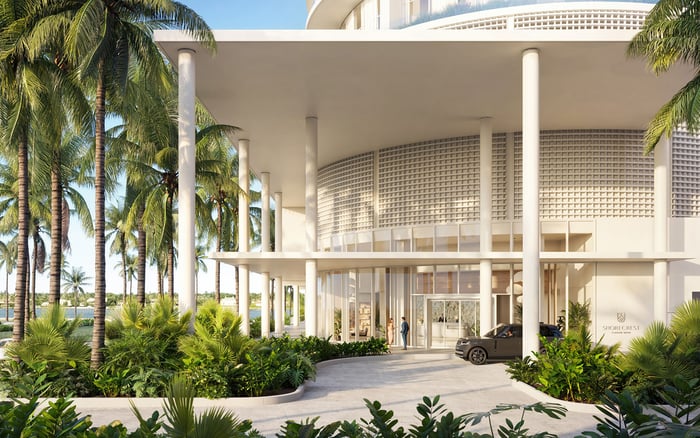
For buyers considering Alba West Palm Beach, a credible appraisal should distinguish residence-specific attributes, customization, asking evidence and verified transaction evidence rather than relying on a broad price-per-square-foot comparison.

For buyers considering Alba West Palm Beach, the central appraisal question is not simply whether another condominium sold nearby. It is whether the available evidence reflects the specific residence being acquired. That distinction becomes especially important for a penthouse or a home with extensive customization, where broad averages can conceal meaningful differences.
The strongest valuation explains why each comparison is relevant and how each adjustment relates to the residence.
A contract price and an appraised value can differ without making either figure arbitrary. A buyer may place particular importance on a combination of outlook, privacy, layout, outdoor utility or finish quality that is not fully represented by recent evidence. A disciplined appraisal makes those distinctions visible rather than folding them into one unexplained premium.
The analysis should generally begin with the most relevant evidence within Alba. A same-building residence shares important context that a property elsewhere may not, but that does not make every Alba residence interchangeable. The appraiser still needs to consider differences in floor position, orientation, interior area, layout, exterior space, parking, privacy and condition.
When internal evidence is limited, the search can expand to other West Palm Beach luxury properties. Projects such as Forté on Flagler West Palm Beach, The Ritz-Carlton Residences® West Palm Beach and South Flagler House West Palm Beach may help a buyer understand the competitive field. Their usefulness in an appraisal, however, depends on the appraiser identifying and adjusting for material differences rather than treating nearby luxury developments as direct substitutes.
This layered approach is more informative than selecting properties only because they are geographically close or share a luxury label. The objective is to establish a reasoned chain from the best internal evidence to the most relevant external evidence, with the limitations of each comparison stated clearly.
Price per square foot can help organize evidence, but it should not determine value by itself. Two residences with similar interior area can appeal to different buyers because of their floor plans, outlooks, ceiling conditions, privacy, exterior areas or relationships between primary rooms and terraces. A single building-wide average can flatten those distinctions.
The appraisal should therefore explain both the quantitative and qualitative differences among the selected properties. If one residence is larger but less functional, the analysis should address utility rather than assume that every additional square foot contributes equally. If another has a more compelling outlook or a more usable terrace, that attribute should be discussed independently instead of being hidden in a general adjustment.
A buyer reviewing the report should be able to follow the logic from each comparable to the final conclusion. If the analysis relies heavily on an average, the buyer can ask whether the underlying residences genuinely compete with the subject home.
A penthouse premium is rarely attributable to one feature. It can reflect a combination of elevation, view quality, privacy, ceiling conditions, elevator access, parking, layout and exterior space. A credible appraisal should identify which of those attributes are present and evaluate them individually where the evidence permits.
View analysis should go beyond a simple label. Direction, breadth, obstruction, perceived permanence and the outlook from primary rooms can all influence buyer response. Elevation may matter, but it should not be used as a substitute for examining what the residence actually overlooks.
Outdoor areas also require separate judgment. Their contribution can depend on depth, exposure, privacy, access from interior rooms and practical furnishing potential. Exterior space should not automatically be treated as equivalent to air-conditioned interior area, nor should every terrace receive the same adjustment.
Functional distinctions are equally important. A residence with a strong floor plan may compete differently from a larger home with less efficient circulation. Parking and private access can also affect utility, but their treatment should be supported by the comparison set rather than assumed.
Highly customized residences require the appraiser to distinguish three concepts: the value of the residence before customization, the documented cost of the work and the contributory value recognized by the market. Those figures are not necessarily the same.
A buyer may value a particular material, layout change or design decision more highly than the broader buyer pool does. Conversely, coordinated improvements that enhance function, storage, lighting or the connection between indoor and outdoor areas may improve market appeal. The appraisal should explain that relationship instead of equating invoices with value.
Documentation can help establish the scope and quality of the work. Buyers should organize contracts, invoices, plans, specifications and a clear description of changes before the appraisal inspection. These materials do not prove a dollar-for-dollar increase, but they can help the appraiser distinguish substantive improvements from cosmetic preferences.
The selected comparables matter here as well. If a comparison already reflects a similar finish level, an additional adjustment may be limited. If the subject residence is materially different, the report should identify the quality gap and explain how the evidence supports the adjustment.
Active listings and asking prices can show how sellers position residences, but they do not represent completed transactions. Contract evidence and closed sales may be more persuasive when they are verified and genuinely comparable. An appraisal should state what type of evidence is being used and why each item receives its assigned weight.
This distinction is particularly important when the available set includes differently configured residences or homes with varying levels of customization. A high asking price does not establish value on its own, just as a lower transaction elsewhere may not control the analysis if the property differs materially in outlook, privacy, layout or condition.
The reconciliation section should connect the evidence rather than merely average it. Buyers can look for an explanation of which comparisons received the greatest emphasis, which required the largest adjustments and how uncertainty affected the conclusion.
Before the inspection, the buyer and advisers can assemble the contract, floor plan, parking information, customization records and a concise list of residence-specific attributes. The goal is not to direct the appraiser toward a predetermined number. It is to ensure that relevant distinctions are documented and available for independent analysis.
The buyer can also ask practical questions when reviewing the report:
Which properties establish the closest baseline for the residence?
How were floor position, outlook, privacy, layout and exterior utility addressed?
Were customization costs separated from contributory market value?
How much weight was assigned to listings, contracts and closed transactions?
Were broader West Palm Beach comparisons adjusted for meaningful differences?
A well-supported conclusion may still differ from the negotiated price. The value of rigorous methodology is that it makes the reasoning transparent, highlights the limits of the evidence and gives the buyer a clearer basis for evaluating the capital decision.
For discreet guidance on Alba and South Florida’s luxury residential market, connect with MILLION.
If branded residences are on your mind — as a home or as an allocation — we would be glad to share what we are seeing, privately.
Begin a quiet conversationA penthouse may differ from other residences in outlook, privacy, layout, exterior space and finish quality. The appraisal should identify those distinctions rather than rely on a broad average.
The most comparable same-building evidence can provide a useful starting point. Each residence still needs adjustments for its material differences.
No. It can organize evidence, but it does not independently account for layout, view, elevation, privacy, outdoor utility or customization.
The analysis should consider direction, breadth, obstruction and the outlook from important rooms. A general view label may not capture those differences.
Terraces should be considered separately from interior living area. Their privacy, depth, exposure, room access and usability can affect their contribution.
Not necessarily. The appraiser should distinguish documented expenditure from the value that the market recognizes.
Contracts, invoices, plans, specifications and a concise list of changes can clarify the scope and quality of the work. They do not guarantee an equal increase in value.
They can provide context for current seller positioning. They should be clearly distinguished from verified contracts and closed transactions.
They may provide broader market context when internal evidence is limited. Material differences in setting, layout, services and residence attributes require explicit consideration.
The buyer should examine comparable selection, adjustment logic, evidence weighting and the treatment of customization. The report should explain how those elements support the conclusion.