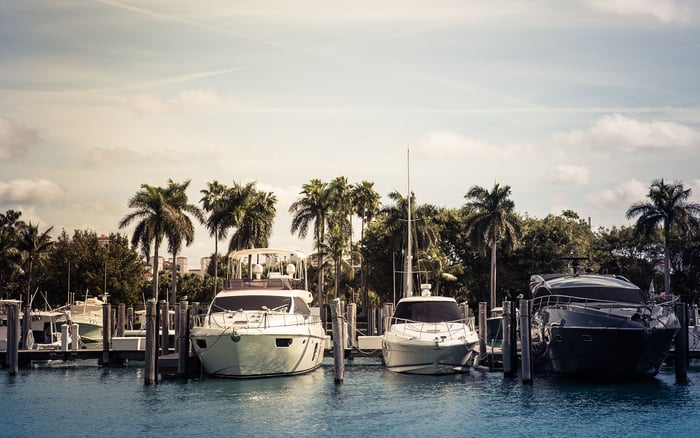
For yacht-owning buyers, Fisher Island offers bridge-free Atlantic access and unusually substantial marina capacity, while Key Biscayne favors easier road logistics and moderate-size vessels docked nearby. The right purchase depends on air draft, water draft, vessel length, berth availability, and how the crew operates day to day.
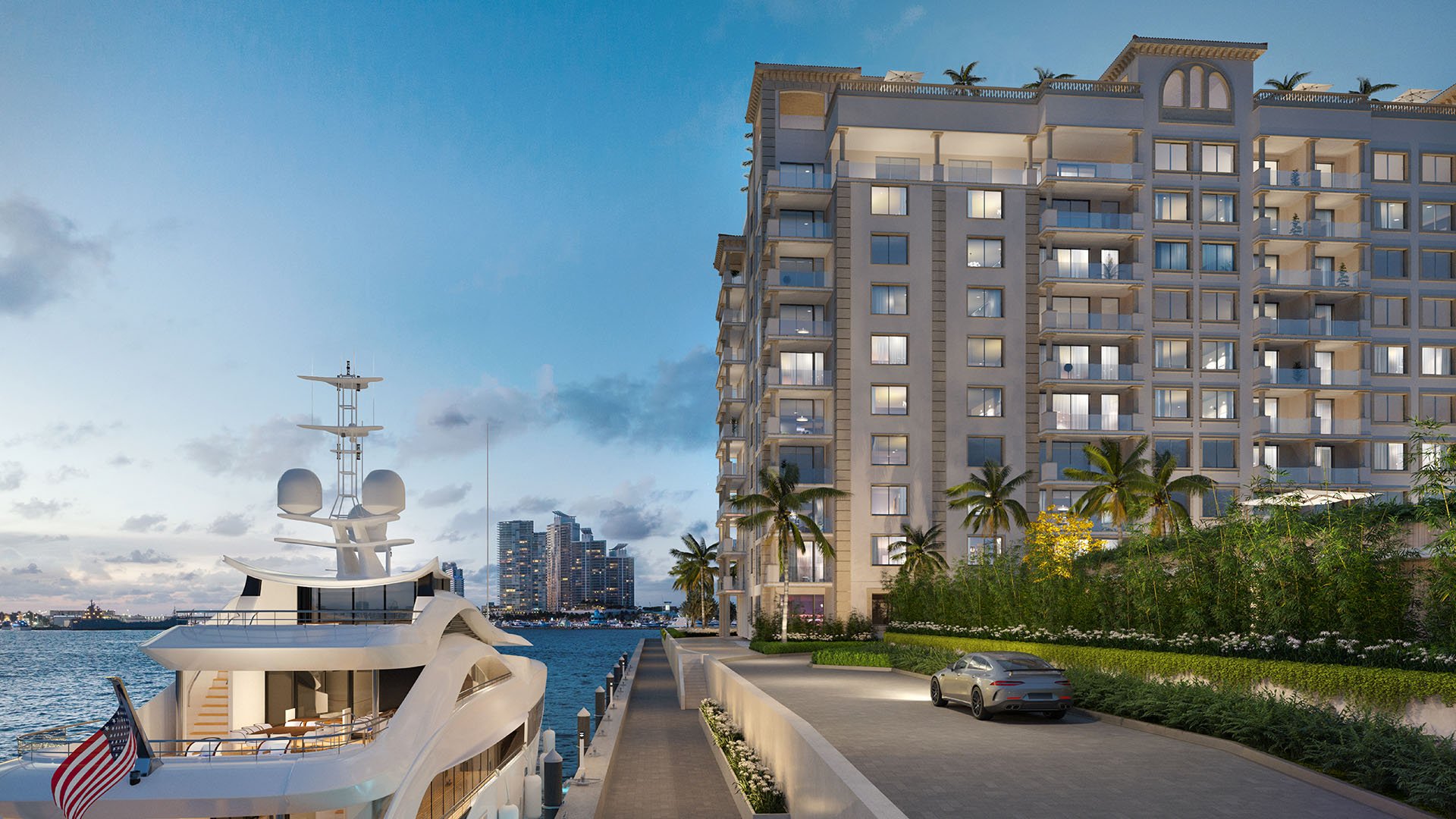
For a buyer who owns a serious yacht, Fisher Island and Key Biscayne are not interchangeable versions of waterfront Miami. They represent two distinct operating models. Fisher Island brings residence, club life, and deep-water marina infrastructure together within one controlled island community. Key Biscayne offers direct road access and a relaxed residential setting, but larger yachts are generally kept at nearby facilities rather than in a comparable, residentially integrated superyacht marina.
The first screen should therefore be technical, not aesthetic. Maximum vessel length, beam, water draft, air draft, appendages, shore-power requirements, and berth configuration must be tested before floor plans are compared. A residence can be ideal in every conventional sense yet operationally wrong if the yacht cannot clear the route or safely reach its assigned slip.
The best address is the one that works for both the residence and the yacht.
No fixed bridge lies between Fisher Island's marinas and Government Cut. This bridge-free route removes a fixed air-draft ceiling on the passage to the Atlantic, a defining advantage for tall sailing rigs and multi-deck motor yachts. It also eliminates one of the most consequential variables in South Florida yacht ownership: whether antennas, masts, communications equipment, or upper structures fit beneath a bridge.
Fisher Island Club operates the Main Marina and Vanderbilt Marina. Dimensions include a 15-foot approach depth, with 8 feet inside the Main Marina and 12 feet inside Vanderbilt. The broader marina operation comprises 118 deep-water, surge-protected berths and can accommodate vessels as long as 76 meters, or approximately 250 feet. Capacity does not guarantee a suitable or available berth, but the scale establishes Fisher Island as a realistic residential base for yachts far larger than those typically served around Key Biscayne.
That integrated proposition complements residences such as The Residences at Six Fisher Island and Palazzo del Sol. The relevant luxury is not simply a water view. It is the potential to keep a large vessel, home, and private club environment within the same controlled community.
Key Biscayne suits a different owner profile. The island is connected by the Rickenbacker Causeway, making crew turnover, provisioning, contractor access, and trips to shipyards more straightforward by car. That convenience can be significant for a professionally managed yacht with frequent deliveries or rotating personnel. The trade-off is that the vessel may be separated from the residence by a drive across the causeway.
The fixed Rickenbacker Causeway bridge has a vertical clearance of 76 feet and a horizontal clearance of 120 feet. A lower-profile motor yacht may work within that envelope, but a large sailing yacht or unusually tall multi-deck vessel may not. The yacht's maximum air draft must include antennas and every relevant appendage, not merely the principal superstructure. Water level can also affect practical clearance, so the nominal figure should never be treated as the sole navigational answer.
Rickenbacker Marina has wet-slip capacity for as many as 200 vessels, accommodating yachts up to 100 feet and drafts up to 9 feet. Other available figures place minimum approach, channel, and mean-low-water dock depths at approximately 7 feet. Those differing dimensions make route-specific verification essential. An 8-foot-draft yacht cannot safely rely on a deeper berth if the channel reaches only 7 feet at mean low water.
For buyers considering Oceana Key Biscayne, the residence and yacht should be evaluated as a two-location system. Key Biscayne can be the better lifestyle choice when the vessel fits nearby infrastructure and road convenience matters more than keeping a superyacht within the residential community.
Fisher Island has no road or causeway connection. Residents, guests, crew, contractors, and vendors arrive by authorized ferry or approved vessel, and ferry guests require pre-arranged security clearance. This structure supports privacy and controlled access, but it rewards disciplined scheduling. Regular crew commuting is feasible; spontaneous personnel changes and last-minute contractor arrivals are less flexible than at a publicly accessible marina.
Owners attracted to The Links Estates at Fisher Island should ask the captain to model a normal operating week. That exercise should cover shift changes, provisioning windows, maintenance teams, guest embarkation, package handling, and urgent technical visits. The operational question is not whether access is possible. It is whether the household and crew prefer a controlled rhythm to mainland spontaneity.
Key Biscayne reverses that equation. Road access simplifies routine movement, yet the captain may need to coordinate between an off-site berth and the owner's home. Privacy is less integrated, but service logistics can be more fluid. For an owner who uses a moderate-size yacht and prioritizes effortless crew turnover, that separation may be an acceptable compromise.
Boat-slip due diligence should precede any residential commitment. Request written confirmation of maximum permitted length, beam, draft, shore power, security protocols, liveaboard rules, and long-term slip availability. Confirm whether the quoted depth applies to the approach, channel, fairway, or berth, then determine the controlling figure at relevant tides.
Air draft deserves equally exact treatment. Buyers navigating near Key Biscayne should compare the vessel's fully configured maximum height with current charts, tides, temporary restrictions, and applicable notices. At Fisher Island, the bridge-free route resolves the fixed-clearance issue, but draft, beam, turning room, and berth configuration still require confirmation.
This comparison belongs in practical buyer's guides because the conventional hierarchy of finishes, amenities, and views is secondary to navigability. A waterfront residence is not automatically a yacht residence, and proximity to a marina does not establish compatibility. The boat slip, route, and crew plan must work together.
Fisher Island is the clearer choice for superyachts, tall rigs, direct ocean access, and owners who want residence and large-yacht dockage within one private ecosystem. Its marina dimensions are substantially better suited to vessels approaching 150 to 250 feet or drawing roughly 10 feet than the approximately 100-foot length and 7-to-9-foot depth parameters associated with Rickenbacker Marina.
Key Biscayne is more compelling for moderate-size yachts that fit the bridge and channel constraints, particularly when easy road access for crew, provisioning, and maintenance carries greater weight. Its advantage is logistical flexibility on land, not integrated superyacht infrastructure.
The decisive answer should come from the captain's specifications and the family's operating preferences. If bridge clearance and very large-vessel capacity are nonnegotiable, Fisher Island leads. If the yacht fits nearby facilities and the crew needs frictionless road access, Key Biscayne may offer the more comfortable balance.
For discreet guidance on aligning a South Florida residence with your yacht program, connect with MILLION.
If branded residences are on your mind — as a home or as an allocation — we would be glad to share what we are seeing, privately.
Begin a quiet conversationFisher Island is generally stronger for superyachts because it combines substantial marina capacity with a bridge-free route to Government Cut and the Atlantic.
No fixed bridge lies between Fisher Island's marinas and Government Cut, so the route does not impose a fixed air-draft ceiling.
The fixed bridge has a published vertical clearance of 76 feet and horizontal clearance of 120 feet. Actual operating clearance can vary with water level.
Its published capacity extends to vessels as long as 76 meters, or approximately 250 feet, subject to berth availability and configuration.
The published approach depth is 15 feet, with 8 feet inside the Main Marina and 12 feet inside Vanderbilt Marina.
Rickenbacker Marina reports capacity for yachts up to 100 feet and drafts up to 9 feet, while other published figures indicate depths around 7 feet in parts of the route and dockage.
The yacht must safely traverse the shallowest controlling part of the route. A deeper berth does not help if the approach channel is too shallow.
Key Biscayne is easier for road-based crew changes and provisioning. Fisher Island requires authorized ferry or approved-vessel access and advance clearance for guests.
It depends on the yacht's complete air draft relative to the bridge's operating clearance. Tall masts and appendages can make the fixed bridge unsuitable.
No. Buyers should confirm availability, length, beam, draft, shore power, access rules, security, and berth configuration directly before purchasing.