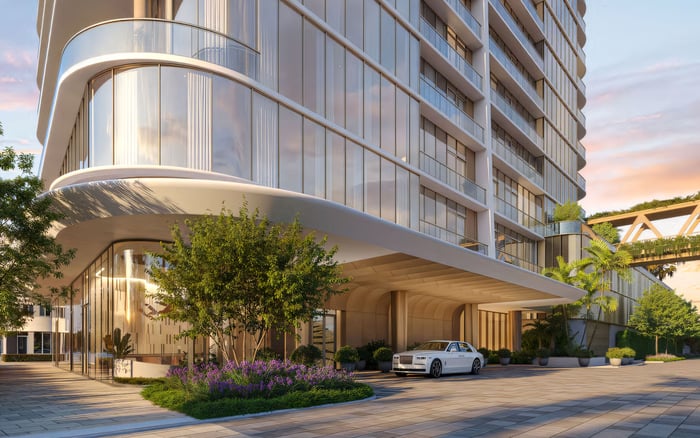
Villa Miami’s service-led residential proposition calls for equally exacting financial diligence. Buyers should reconcile budget revisions, test staffing coverage, review contract escalators, and distinguish assessment-funded operations from personal spending before underwriting ownership costs.

At Villa Miami, the ownership proposition extends beyond a waterfront home in Edgewater. Developed by Terra with a Major Food Group-branded residential experience, the project markets dining, wellness, leisure programming, and personalized household support as part of its appeal. For a buyer, the financial question is not simply what the building offers, but how that offering translates into recurring obligations.
Decision-grade diligence connects every material service promise to a budget assumption, an operating responsibility, and a contractual commitment. A polished amenity description establishes the intended experience-not final payroll, executed service terms, insurance costs, or recurring assessments. The purchase decision should distinguish what is marketed, what is documented, and what remains an underwriting assumption.
Begin with the latest developer budget, earlier versions, and the purchaser documents explaining the unit’s assessment allocation. Request a line-by-line reconciliation rather than a comparison of headline totals. A stable total can conceal shifts among payroll, insurance, maintenance, reserves, and contracted services.
For each material change, ask whether it reflects service scope, pricing, timing, or accounting treatment. Identify any developer subsidy, deferred expense, or phased service opening. Then request a stabilized post-turnover view showing the cost of the intended operation without temporary support. These are diligence requests, not assertions that Villa Miami has adopted any particular subsidy or operating arrangement.
Do not underwrite from an indicative HOA figure alone. Confirm its annual-versus-monthly basis, applicable square-footage definition, inclusions, and current validity against purchaser documents. Scrutinize the assessment allocation as well: verify the unit’s percentage ownership interest and how the approved association budget translates into its obligation. Do not assume a marketing rate is individually negotiable.
Villa Miami advertises 24-hour concierge, valet, and security, including a 24-hour porte-cochère with valet service. It also markets an estate manager and an in-house curator to coordinate household support, leisure activities, personal requests, and reservations. Review these functions separately rather than compressing them into a single service allowance.
Continuous coverage is not the same as one budgeted employee. Request headcount by role and shift, distinguishing employees from contractors and identifying provisions for leave, holidays, absences, and overlapping demand. Ask whether supervisory coverage and relief staff fall within the payroll line or a separate contract. The objective is to understand how the promised hours are funded, not to infer an undisclosed staffing count.
The labor schedule should show wages, benefits, payroll taxes, overtime, holiday coverage, and wage-growth assumptions. Household staffing coordination needs a clear boundary of its own: arranging a resident’s private staff does not establish that those employees are association-funded. Buyers comparing EDITION Edgewater can apply the same coverage questions to that property’s documents without assuming equivalent staffing or costs.
A first-year contract price is only the starting point. Request executed agreements for material services and identify fixed annual increases, CPI-linked adjustments, wage pass-throughs, insurance pass-throughs, and minimum staffing commitments. Where pricing depends on an index, confirm which index applies, when adjustments occur, and whether the agreement specifies a floor or cap.
Review these mechanisms together. Ask whether a scheduled increase can apply alongside a separate wage adjustment, and whether changes to service hours affect both staffing charges and management fees. Villa Miami’s executed escalators are not established here; these are provisions to investigate, not disclosed project terms.
Renewal rights, termination fees, notice requirements, and developer-affiliated counterparties also deserve scrutiny. Request a schedule showing contract duration, renewal dates, and the association’s ability to change providers. For a buyer also considering Cipriani Residences Brickell, this creates a consistent comparison framework without implying that the two projects share contractual structures.
Villa Miami’s advertised dining and social program includes a resident-only MFG restaurant, private dining areas, and The Copper Club members’ club. Its marketed privileges include access and charging privileges across MFG restaurants, priority access, and event invitations. None of these descriptions establishes that restaurant spending is included in condominium assessments.
Request a written service matrix separating association-funded operations from resident-paid consumption. Dining bills, spa treatments, events, personal shopping, travel arrangements, private aviation coordination, and household support should each have a clear billing explanation. Distinguish the cost of maintaining access from the cost of using a service.
That distinction is equally useful when reviewing St. Regis® Residences Brickell. Compare each property’s documented inclusions, optional charges, and operating obligations-not the perceived equivalence of luxury brands.
Villa Miami’s amenity program spans approximately 20,000 square feet across three private-club levels, identified as Levels 3-5. The marketed thermal spa includes plunge pools, saunas, steam rooms, treatment rooms, and a relaxation lounge. Fitness facilities include Technogym equipment and yoga, Pilates, and boxing studios; additional amenities include a bayfront pool deck, cabanas, a screening room, and a children’s playroom.
For each area, request operating hours, staffing responsibility, maintenance assumptions, and reserve treatment. An amenity’s footprint is no substitute for its operating schedule. Ask how costs for commercial areas, parking, and shared infrastructure are allocated so that the association-funded portion is clear.
The private dock and rooftop helipad require particular care. These facilities are planned and subject to permitting and governmental approvals. Keep approval status separate from assumptions about access, operation, maintenance, insurance, and infrastructure allocation. Do not assign guaranteed utility or a settled recurring cost to either facility without supporting documents.
Prepare developer, stabilized, and downside cases as an underwriting exercise. This is a buyer’s analytical framework, not a disclosed Villa Miami requirement. Show operating expenses, insurance, reserves, and contract escalation separately in each case, with personal spending outside the association assessment.
The developer case should follow the current documented budget. The stabilized case should reflect the intended full-service operation after any temporary support or ramp-up arrangements. The downside case should test less favorable labor, insurance, and contractual assumptions without presenting those scenarios as forecasts.
The final decision should reconcile the service matrix, staffing schedule, contract register, and unit-level assessment calculation. Any unresolved item should remain visible as an assumption rather than disappear inside a blended ownership-cost estimate. The aim is not to diminish the experience, but to understand the financial commitments that sustain it.
For a discreet perspective on South Florida’s most considered residential opportunities, explore MILLION.
If branded residences are on your mind — as a home or as an allocation — we would be glad to share what we are seeing, privately.
Begin a quiet conversationDetermine how the marketed service experience translates into documented recurring obligations. Connect material services to budget assumptions, operating responsibilities, and contractual commitments.
No. Confirm its annual-versus-monthly basis, square-footage definition, inclusions, and validity against purchaser documents and the applicable budget.
Request the latest developer budget, earlier versions, and a stabilized post-turnover view. Reconcile changes in scope, pricing, timing, subsidies, and service ramp-up assumptions.
Villa Miami advertises 24-hour concierge, valet, and security, including a 24-hour porte-cochère with valet service. Advertised coverage alone does not establish final staffing counts or payroll assumptions.
Request headcount by role and shift, employment status, wages, benefits, payroll taxes, overtime, holiday coverage, and wage-growth assumptions. Distinguish continuous coverage from a single budgeted position.
Review fixed and CPI-linked increases, wage and insurance pass-throughs, and minimum staffing commitments. Also examine renewal rights, termination fees, and developer-affiliated counterparties.
The marketed restaurant access and charging privileges do not establish that dining spending is included. Obtain a written explanation separating assessment-funded operations from resident-paid purchases.
The amenity program spans approximately 20,000 square feet across three private-club levels, identified as Levels 3–5. Buyers should verify each area's operating hours, staffing, maintenance, and reserve assumptions.
No. The private dock and rooftop helipad are planned and subject to permitting and governmental approvals.
Model developer, stabilized, and downside cases, separating operating expenses, insurance, reserves, contract escalation, and personal spending. This is an underwriting recommendation, not a disclosed project requirement.