
A financed purchase at 619 Residences requires more than confidence in the asset. With completion generally projected for 2030 and 60% of the purchase price due at closing under the published schedule, buyers should prepare for unit-specific appraisal risk, changing borrowing costs and a potentially larger equity requirement at delivery.

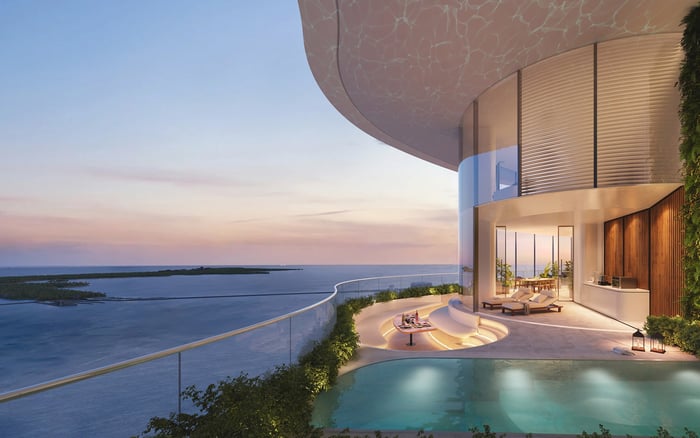
At 619 Residences by Foster + Partners + Nobu Hospitality, the proposition combines a Biscayne Bay address, architecture by Foster + Partners and Nobu’s hospitality identity. Led by 13th Floor Investments and Key International, the development is planned for 619 Brickell Avenue beside Brickell Park. The 75-story tower will comprise 296 residences, with Foster + Partners leading the design, Sieger Suarez Architects serving as architect of record and Studio Munge creating the interiors.
For a cash purchaser, the years between contract and completion principally shape liquidity planning. For a financed purchaser, they introduce two variables that signing early cannot fix: the lender’s eventual valuation and the cost of debt near delivery. Completion is generally projected for 2030, so a mortgage quotation obtained today should not be treated as a closing commitment.
The decisive financing conditions are likely to emerge near delivery, not at contract.
That distinction is central to this Buyer’s Guides analysis. In a Pre-Construction acquisition, a residence may be selected years before the final loan is underwritten, appraised and funded. A buyer can have ample wealth yet still face a materially different capital requirement at closing than originally modeled.
The payment schedule calls for 15% at contract, 15% at groundbreaking, 10% one year after contract and the remaining 60% at closing. In practical terms, 40% is committed before delivery, while the largest single obligation arrives precisely when valuation and financing must align.
The executed purchase agreement remains controlling, and its terms should be reviewed independently. Even so, this structure illustrates the core issue: deposits already paid do not eliminate closing risk. If the lender advances less than anticipated, the purchaser may need additional liquid equity to complete the final payment.
That is especially relevant at the upper reaches of the planned inventory, which spans one- to four-bedroom homes, Sky Villas and penthouses. Asking prices have ranged from approximately $2.72 million to $11.19 million, underscoring the scale of the closing obligation. Early pricing has been positioned around $2,100 to $2,300 per square foot, with later pricing anticipated above $2,600 per square foot. Those figures provide context, not a guaranteed future appraisal.
A closing appraisal is a unit-specific conclusion based on the valuation evidence available at that time. If it falls below the contract price and financing is sized from the lower value, the shortfall can shift directly to the buyer’s equity requirement. The residence has not necessarily become less desirable; the lender may simply recognize less collateral value than the buyer agreed to pay.
The branded proposition is substantial. The tower will be Nobu’s first residential project in Miami, with approximately 90,000 square feet of private amenities planned. Announced elements include spa and wellness facilities, fitness spaces, pool areas and a Nobu restaurant. Yet even among Branded Residences, service, design and amenity depth do not replace the closed comparable transactions used in valuation.
Sky Villas and penthouses may warrant particular care because unusually large or distinctive layouts can yield fewer directly comparable sales. Floor, view, size, configuration, finish level and market conditions near delivery can all influence the available evidence. A purchaser should therefore model the possibility that the contract premium and appraised premium will not be identical.
For broader Brickell context, buyers may study other approved offerings such as The Residences at 1428 Brickell and Cipriani Residences Brickell. These are not automatic appraisal substitutes for 619 Residences. They underscore that brand, architecture, delivery stage, floor plan and view must be evaluated at the individual-property level.
A conventional mortgage rate available when a buyer reserves or contracts for a home should not be assumed to remain available in 2030. Lender-specific rate-lock periods, loan-to-value limits and foreign-national terms remain unspecified. Those details must be confirmed directly with the institution expected to fund the purchase.
The prudent model is therefore a range, not a single interest-rate assumption. A higher cost of debt can alter monthly carrying expense, debt-service preferences and even the amount a buyer elects to borrow. The most demanding scenario combines less-favorable borrowing costs with an appraisal below the contract price just as the final 60% becomes due.
A nearby project such as St. Regis® Residences Brickell can help a purchaser frame the wider field of hospitality-led ownership, but it cannot determine the future rate or valuation for a residence at 619 Brickell. Financing remains specific to the borrower, unit, lender and closing date.
The strongest preparation begins by separating the acquisition into three capital decisions: the deposit commitment before delivery, the anticipated loan at closing and a liquidity reserve for any difference between planned and approved financing.
Well before the closing window, the buyer and lending team should revisit financial documentation, the intended borrowing structure and the property information required for underwriting. As delivery approaches, the appraisal should be treated as a live transaction milestone rather than an administrative formality. Buyers considering a rare configuration should ask how the lender will evaluate limited comparables and what happens if approved proceeds fall short.
It is also sensible to compare a financed case with a lower-debt alternative. This does not require predicting a single future rate. It requires understanding how much additional equity could be made available without disrupting the buyer’s broader liquidity strategy. The objective is optionality: the capacity to close even when valuation and borrowing conditions are less accommodating than the original base case.
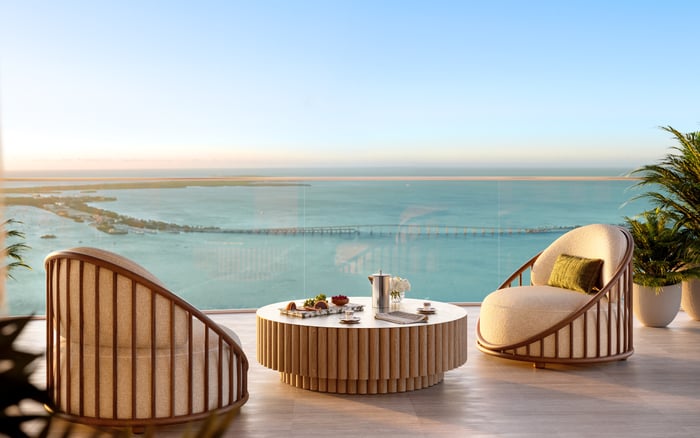
The Waterfront setting, bay views and private amenity program define the lifestyle thesis. The ownership thesis is completed by a capital plan that remains workable through 2030. For financed trophy purchases, the essential question is not merely whether credit is available today, but whether the buyer can absorb a lower valuation, a higher borrowing cost or both when the balance comes due.
Prospective purchasers can review the residence and coordinate a discreet acquisition strategy with MILLION.
If branded residences are on your mind — as a home or as an allocation — we would be glad to share what we are seeing, privately.
Begin a quiet conversationCompletion is generally projected for 2030, creating a multiyear interval between contract and closing.
The marketing schedule calls for 15% at contract, 15% at groundbreaking, 10% one year after contract and 60% at closing.
If financing is sized from an appraised value below the contract price, the buyer may need to contribute more equity at closing.
A rate available today should not be assumed to remain available in 2030. Any lock period must be verified directly with the buyer’s lender.
Sky Villas and penthouses may have fewer directly comparable transactions because of their size and configuration.
The planned 75-story building will comprise 296 residences.
The inventory is planned to include one- to four-bedroom residences, plus larger Sky Villas and penthouses.
The project is planned with approximately 90,000 square feet of private amenities.
No. Branding and amenities support the value proposition, but the appraisal will depend on unit-specific evidence and market conditions near delivery.
The most difficult case combines a low appraisal with less-favorable borrowing costs when the final 60% payment becomes due.
.jpg&width=700&height=438&fit=cover)