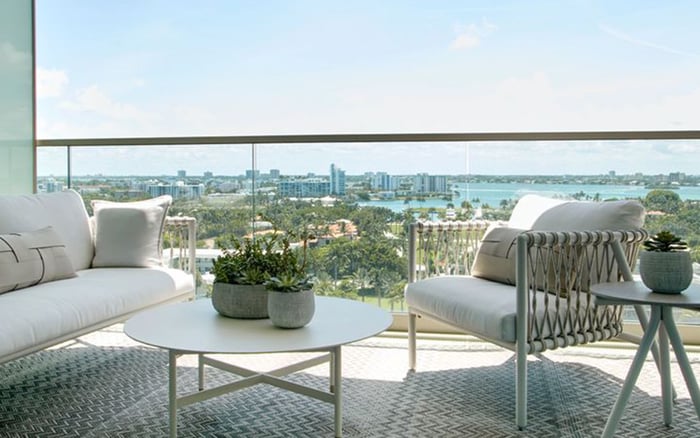
A considered Houston-Bal Harbour lifestyle requires more than two well-appointed residences. Coordinate collection inventories, conditioned storage, backup power and insurance so wine and art remain protected between visits and during transfers.

A life divided between Houston and Bal Harbour should feel effortless: familiar bottles ready for dinner, meaningful works installed where they can be enjoyed, and neither residence dependent on the owner’s constant attention. That ease begins with treating the collection as part of the property decision, not as a furnishing exercise after closing.
The essential questions are practical. Where will each object live? What maintains its environment when the residence is empty? Who responds to an alarm, and which policy applies during a move between cities? For buyers considering Oceana Bal Harbour, those questions belong alongside layout, light and the experience of arrival. A beautiful room and a documented protection plan serve different purposes; a serious collection deserves both.
Maintain one digital inventory with separate location fields for the Houston residence, the Bal Harbour residence, third-party storage and items in transit. Treat it as the household’s working record, with every movement reconciled rather than remembered.
For art, assemble the documentation an insurer may request: inventories, appraisals, provenance, storage information and transit exposure. For wine, identify holdings, locations and declared values so the record serves both the household and the insurance adviser. Keep supporting documents accessible to those authorized to act while you are away.
Review the operating inventory and insurance schedule together, but do not assume that updating one automatically updates the other. Recent acquisitions and changes in declared values both require attention. Before a seasonal move, ask the adviser whether a location change requires notification or an amendment.
Start by distinguishing what you want available for daily enjoyment from what you prefer to keep in dedicated storage. That decision can shape the size of an in-residence wine installation and the amount of art requiring a plan for periods of absence.
For wine, approximately 55°F and 65-75% relative humidity provide a planning reference, with consistency central to the brief. Do not automatically apply those conditions to artwork. Ask the appropriate collection specialist to establish art-storage requirements separately.
Houston offers specialized wine-storage arrangements with different access and resilience features. Access options include daily hours from 6:00 a.m. to midnight and around-the-clock access. Backup provisions include natural-gas generation in one arrangement and redundant refrigeration with a backup generator in another. These features are starting points for questions, not substitutes for a written service review.
Request details on generator capacity, testing, refrigeration redundancy, monitoring and alarm response. Establish who receives an alert and who can enter the storage space to intervene. Convenience matters only when the response arrangement is equally clear.
For a collection owner, the question is not simply whether a building has a generator, but whether the systems serving the collection continue operating during an outage. Ask management exactly which in-unit systems receive backup power, including apartment HVAC, cellar refrigeration, humidity controls and alarms.
When evaluating Rivage Bal Harbour, request that information as part of the property review. Do not assume that building-level backup extends to a private wine room. No project-specific backup capability should be inferred from the residence’s positioning or presentation.
The objective is automatic backup capable of supporting temperature controls, humidity controls and alarm systems. Have the relevant professionals assess whether the actual arrangement meets that objective. Obtain written details on supported equipment, testing and response responsibility. Before commissioning a cellar, identify any gap between building services and owner-installed systems.
Storm readiness should influence placement before installation. Review hurricane shutters or impact-rated glass across all perimeter openings. Establish a plan to move artwork away from windows, doors, exterior walls and locations directly beneath roofing when severe weather threatens.
If the property search extends into Surfside, apply the same collection-focused questions when considering Ocean House Surfside. The purpose is not to presume a weakness or a protection, but to understand how a particular residence would function while its owner is in Houston.
For stored art, a recommended precaution is elevation of 3-6 inches above the floor on sturdy shelving or foam blocks, along with avoiding below-grade or flood-prone storage. That modest elevation is no substitute for flood planning. Identify a suitable interior holding area and confirm who is authorized to relocate works, contact handlers and coordinate with building management.
Ordinary homeowners sublimits may be inadequate for valuable collections. Review dedicated protection with the adviser, including scheduled or agreed-value coverage where appropriate. Coverage structures for both art and wine can include blanket coverage, individual itemization or a combination. The right arrangement depends on the holdings and the actual policy terms.
Distinguish collection contents from the residence, cellar construction, cooling equipment and custom fixtures. Ask which policy responds to each category rather than treating the entire installation as one insured asset.
Wine programs can offer protection for fire, theft, accidental breakage, water damage, temperature damage and transit. Utility-service interruption and mechanical-breakdown spoilage protection may also be available, but neither should be assumed. Confirm the wording, exclusions and applicable deductibles before relying on coverage.
For Bal Harbour, review separate NFIP or private-flood options and the treatment of collection contents. Do not assume homeowners insurance covers flood. Ask explicitly about wind deductibles, temporary storage, transit and conditions that apply while the residence is unoccupied.
Third-party storage requires its own allocation of responsibility. A warehouse may offer insurance for an additional fee or require owner-maintained coverage with a waiver. Resolve that distinction before delivery, and have the adviser examine how the storage contract fits the collection policy.
Before leaving either city, reconcile locations, review recent acquisitions and confirm that insured holdings and declared values remain current. Check environmental monitoring and alarm response, confirm authorized contacts, and make sure the storm plan is accessible to those expected to execute it.
Before a transfer, establish transit and temporary-storage coverage rather than waiting until the collection arrives. The goal is not to move every object with every season. It is to make each decision deliberate, documented and manageable from either residence.
For a property search shaped by the way you live and collect, explore South Florida residences with MILLION.
If branded residences are on your mind — as a home or as an allocation — we would be glad to share what we are seeing, privately.
Begin a quiet conversationCreate one digital inventory with separate locations for both residences, third-party storage and items in transit. Reconcile it whenever holdings move.
Approximately 55°F and 65–75% relative humidity provide a planning reference, with consistent conditions a priority. Establish artwork requirements separately rather than applying wine-storage settings to art.
Confirm access hours, generator capacity and testing, refrigeration redundancy, monitoring and alarm response in writing. Establish insurance responsibility before delivery.
No such protection should be assumed. Ask management exactly which in-unit cooling, humidity-control and alarm systems receive generator power.
Plan to move it away from windows, doors, exterior walls and locations directly beneath roofing. Identify authorized people who can carry out that plan while you are away.
A recommended precaution is 3–6 inches on sturdy shelving or foam blocks, while avoiding below-grade or flood-prone storage. This does not replace a broader flood-protection plan.
Available art and wine insurance structures can include blanket coverage, individual itemization or both. Review the appropriate arrangement and policy wording with your adviser.
Do not assume it is. Confirm protection for utility-service interruption and mechanical breakdown of climate-control equipment in the actual policy.
Do not assume homeowners insurance covers flood. Review separate NFIP or private-flood options and confirm how collection contents are treated.
Review them regularly and after acquisitions or changes in declared values. Before transfers, confirm location-notification requirements and transit or temporary-storage coverage.