A disciplined framework for forecasting taxes, association dues, insurance, reserves and financing on a $3 million-plus Miami condominium, with a worked five-year example and clear safeguards against double counting.
For a $3 million-plus Miami condominium, the purchase price is only the opening figure. The more revealing question is how much liquidity ownership will require over five years, including ordinary operations, financing and building-level obligations.
A useful model separates four categories: recurring operating expenses; mortgage payments; special assessments or association debt; and acquisition and exit costs. Keep the purchase price outside recurring carrying costs. An all-cash purchase eliminates mortgage payments-not taxes, dues or reserve exposure.
Whether considering The Residences at 1428 Brickell or another Brickell address, apply the same framework. No fee or assessment assumption in this article represents a quote for a named project.
Begin with taxable assessed value, jurisdiction and the potential reassessment consequences of the purchase. The seller’s current bill is a historical reference, not a reliable forecast of your obligation. Do not automatically equate the purchase price with taxable value.
The worked example below assumes $59,970 in first-year property taxes. This is an illustrative budgeting input, not a current tax quotation or an estimate for a particular residence.
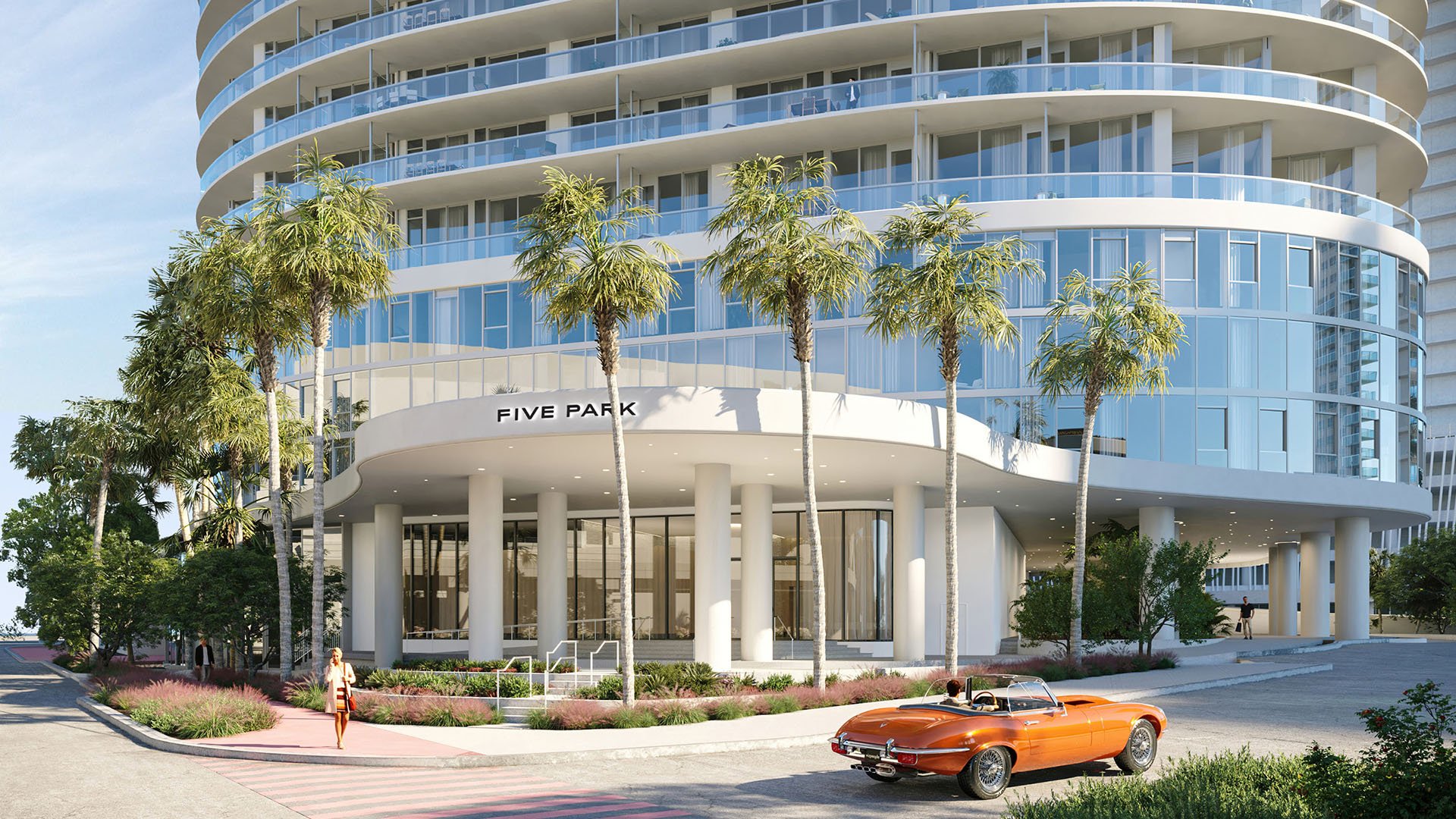
A buyer comparing Five Park Miami Beach with Rivage Bal Harbour should obtain a separate estimate for each property rather than carry one municipality’s assumptions into another. Do not assume homestead benefits for a second home or investment property without confirming eligibility.
Start with the specific unit’s association payment schedule and the budget supporting it. For the worked example, assumed dues of $1.50 per square foot monthly on a 2,000-square-foot residence produce a $3,000 monthly charge, or $36,000 annually. These are modeling assumptions, not market benchmarks.
Dues typically support master building insurance, staffing, security, common-area utilities, maintenance, elevators, amenities, management and reserves. They generally exclude property taxes, individual unit or contents coverage, unit electricity, interior upgrades and special assessments.
For a residence at Aston Martin Residences Downtown Miami, as elsewhere, request the applicable association budget and unit-specific payment schedule. Confirm which services are included before adding separate expenses.
The central safeguard is simple: do not count master insurance twice. Enter the full association charge, then add only owner-paid coverage outside that charge. Apply the same discipline to utilities and reserve contributions already included in dues.
Use five annual columns and a separate assumptions panel. Record each input’s date and supporting document. For expenses without a known future schedule, assign an explicit escalation assumption that can be adjusted independently.
Consider this illustrative, unfinanced scenario for a 2,000-square-foot condo with $3 million of assumed taxable value:
| Operating expense | Year-one assumption | | --- | ---: | | Property taxes | $59,970 | | Association dues at $1.50 per square foot monthly | $36,000 | | Owner-paid insurance | $6,000 | | Unit utilities | $3,600 | | Interior maintenance allowance | $2,400 | | Total recurring operations | $107,970 |
All figures are illustrative modeling assumptions, not property-specific estimates or quotations. The maintenance allowance is a budgeting provision, not necessarily cash spent that year.
For demonstration only, increase every operating line by 3% annually. This is a spreadsheet sensitivity, not a prediction about taxes, premiums or association budgets. Each subsequent year equals the previous year multiplied by 1.03.
| Ownership year | Illustrative operating budget | | --- | ---: | | Year 1 | $107,970 | | Year 2 | $111,209 | | Year 3 | $114,545 | | Year 4 | $117,982 | | Year 5 | $121,521 | | Five-year total | $573,227 |
Figures are rounded to the nearest dollar. Replace the uniform increase with line-specific assumptions as better information becomes available. Maintain both an operating budget and an actual cash-spending view so an unused maintenance allowance is not mistaken for an expense already paid.
Review the building’s Structural Integrity Reserve Study, where applicable, alongside inspection findings, the reserve funding schedule and assessment obligations. Confirm the requirements applicable to the property rather than treating the current dues figure as a complete picture of future funding needs.
An association with insufficient reserves may need assessments, a loan or a line of credit. Borrowing changes the timing of payment; it does not remove the underlying obligation.
Identify what is already included in dues and what the unit owner must pay separately. If association borrowing is repaid through dues, do not count that repayment again as a separate charge.
As a stress test, assume a hypothetical $50,000 assessment payable in year three. The example’s five-year budget rises to approximately $623,227. This is a sensitivity exercise, not an estimate of likely assessment exposure. Show the payment in its due year, and keep any earmarked liquidity outside expenses until paid.
For a financed purchase, add the lender’s actual payment schedule beneath operating costs. Show principal and interest separately: both consume cash, but principal repayment is not the same economic expense as interest. Do not present the full mortgage payment as a pure ownership expense without making that distinction.
Keep acquisition costs, furnishing, discretionary renovations and eventual selling costs in a separate ownership schedule. If a loan balance remains at exit, show it there. This preserves comparability between cash and financed purchases without obscuring their different liquidity requirements.
Before committing, compare a documented base case with a higher-recurring-cost scenario and a separate building-obligation scenario. Focus on the largest annual cash requirement, not merely the five-year average. A manageable total can still conceal an inconvenient concentration of payments.
For a discreet comparison of Miami residences through the lens of long-term ownership, connect with MILLION.
If branded residences are on your mind — as a home or as an allocation — we would be glad to share what we are seeing, privately.
Begin a quiet conversationUse it as a historical reference, not your expected obligation. Build your estimate around taxable assessed value, jurisdiction and potential reassessment after purchase.
No. The model uses $3 million of taxable value as an explicit assumption, which must be replaced with a property-specific estimate.
No, it is an illustrative first-year budgeting assumption. Obtain a tax estimate for the particular residence before relying on the model.
No. Do not include homestead benefits unless you confirm eligibility.
The example assumes $1.50 per square foot monthly for a 2,000-square-foot residence, producing $36,000 annually. Replace that assumption with the specific unit’s payment schedule.
Master building insurance is typically included in dues, while individual unit or contents coverage generally is not. Confirm coverage boundaries and avoid counting the master premium twice.
No. It is an illustrative sensitivity assumption that should be replaced with separate, documented assumptions for each expense line.
The approximately $573,227 total includes modeled taxes, dues, owner insurance, utilities and a maintenance allowance. It excludes financing, special assessments, acquisition costs and exit costs.
No. Borrowing may spread the funding obligation over time, but owners can still face repayment through dues or separate charges.
Review the reserve study, inspection findings, funding schedule and assessment obligations alongside the association budget. Identify which payments are already included in dues before adding separate amounts.