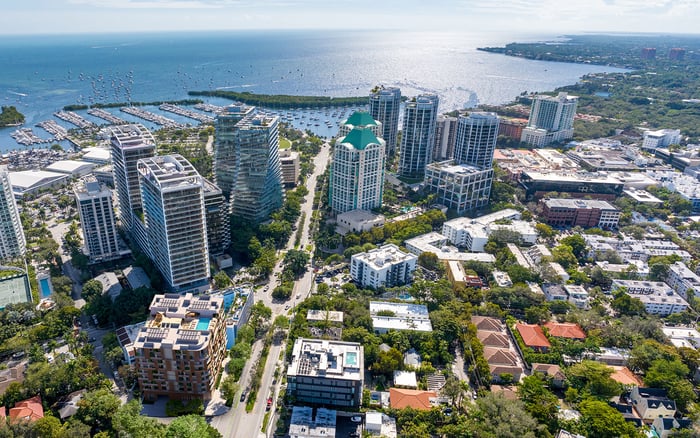
A discreet planning framework for aligning ownership, Florida homestead treatment, financing, privacy, title, and advisers before a Coconut Grove purchase closes.

Before leaving Seattle, settle the most consequential question: Will the Coconut Grove acquisition become your Florida primary residence, or will it remain a rental, flip, or second home? That decision should guide ownership, financing, privacy planning, and closing instructions.
The distinction is especially important in Coconut Grove, where luxury inventory ranges from waterfront estates and condominiums to other high-end residences. A publicly marketed $115 million estate encompassing two waterfront parcels and 174 feet of direct Biscayne Bay frontage illustrates the scale at which a title decision can become an enduring planning decision. For a waterfront acquisition of any size, the more considered approach is to resolve the structure before documents begin circulating.
This edition of MILLION's Buyer's Guides is a coordination framework, not legal or tax advice. The buyer's Florida counsel and tax adviser should tailor every decision to the buyer, property, financing, and intended use.
Florida homestead treatment is not merely a box to check after arrival. Titling a primary residence directly in an LLC can forfeit the homestead exemption and the Save Our Homes assessed-value cap. An LLC may be appropriate for investment property, but that does not make it the default vehicle for a home intended to qualify as a homestead.
A properly structured trust may qualify where an LLC would not. A Florida land trust may also preserve homestead treatment when the resident retains the required beneficial interest, while keeping the beneficiary's name out of title records. The exact trust instrument and retained interest matter. The word “trust” on a draft deed is not, by itself, enough.
That analysis belongs early in the purchase process, whether the residence under consideration is Four Seasons Residences Coconut Grove, promoted as Florida's first standalone Four Seasons-branded residential development, or a private single-family estate.
For rental or other investment real estate, LLC ownership is commonly considered because it can separate property-related liability from personal assets and provide pass-through taxation. When an LLC owns the property, its name generally appears on the deed and tax records rather than the individual owner's name.
More elaborate portfolios may place a trust above a Florida LLC, combining estate-planning and entity-management objectives. A layered arrangement can also place title in one property entity while a separate operations entity handles leasing, maintenance, vendors, employees, and communications. Keeping vendor and employment contracts outside the title-holding entity is intended to isolate operational risk from the real estate.
Those concepts may suit a non-homestead acquisition, but complexity should serve a defined purpose. A buyer comparing Park Grove Coconut Grove with a northeast Coconut Grove house should not assume that condominium and single-family ownership call for identical structures. Grove condominiums have lower homestead rates and higher entity ownership than the neighborhood's single-family homes, but personal use remains the controlling planning question.
The cleanest closing begins with a single written ownership brief. It should identify the intended use of the residence, proposed titleholder, trust or entity name if applicable, financing status, privacy objective, and anticipated homestead position. Circulate it to Florida counsel, the tax adviser, title company, and lender before execution or title transfer.
This avoids a familiar mismatch: counsel prepares a trust, the lender underwrites an individual borrower, and title receives instructions naming an LLC. A sophisticated structure is useful only when the operative documents describe the same transaction. Buyers considering Mr. C Tigertail Coconut Grove or Vita at Grove Isle should make entity review part of the closing calendar rather than a final-week amendment.
Ask each adviser to confirm responsibility. Counsel reviews the deed and trust terms. The tax adviser evaluates the proposed ownership and intended use. The lender confirms acceptable vesting. The title company aligns the closing file with insurability requirements. The buyer then approves one final set of instructions.
First, classify the property as a primary residence, second home, rental, or flip. Second, compare direct ownership, an appropriately structured trust, an LLC, or a hybrid against that use. Third, obtain lender and title acceptance of the exact proposed vesting. Fourth, finalize governing documents and authorized signers before closing paperwork is issued. Finally, confirm that post-closing homestead plans remain consistent with the executed structure.
Privacy, liability separation, estate planning, and tax administration are related objectives, but they are not interchangeable. The strongest Coconut Grove closing is not necessarily the one with the most entities. It is the one in which the deed, beneficial interests, financing, intended occupancy, and operating arrangements tell one coherent story.
Should the ownership decision wait until after the move from Seattle? No. The proposed structure should be reviewed before documents are executed or title is transferred.
Can an LLC-owned Florida primary home receive homestead treatment? Direct LLC ownership can forfeit the homestead exemption and Save Our Homes cap, so Florida counsel should review alternatives.
Does any trust automatically preserve homestead eligibility? No. Eligibility can depend on the trust's precise terms and the resident's retained beneficial interest.
Can a Florida land trust support privacy and homestead objectives? It may keep the beneficiary's name out of title records while preserving treatment if the qualifying beneficial interest is retained.
When is an LLC commonly considered? It is commonly considered for investment real estate when liability separation and pass-through taxation are priorities.
Will an LLC keep every ownership detail private? The LLC's name generally appears on the deed and tax records rather than the individual owner's name.
What is a hybrid ownership structure? One example places a trust above a Florida LLC to coordinate estate-planning and entity-management objectives.
Why separate property ownership from operations? A separate operations entity can handle vendors, employees, leasing, maintenance, and communications apart from the titleholder.
Who should review the structure before closing? Florida counsel, a tax adviser, the lender, and the title company should review the same proposed ownership plan.
What is the first decision for a Coconut Grove buyer? Determine whether the residence will be a homestead, rental, flip, or second home, then build the structure around that purpose.
For a discreet conversation and a curated building-by-building shortlist, connect with MILLION.
If branded residences are on your mind — as a home or as an allocation — we would be glad to share what we are seeing, privately.
Begin a quiet conversation