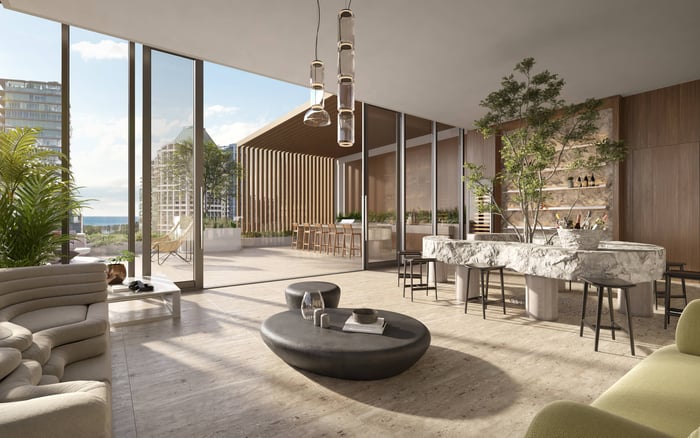
A collector-focused framework for assessing OPUS Coconut Grove, covering daylight, usable wall area, environmental controls, storage, access, security, and art-handling due diligence.

For an art collector, a residence is both a living environment and a setting for viewing, preserving, moving, and securing objects with different requirements. A review of Opus Coconut Grove should therefore focus on the selected residence, its documented specifications, and the operational rules that affect a collection.
A collector-oriented assessment begins with four practical questions: Where will direct and reflected sunlight travel? Which walls remain usable after accounting for openings and building systems? Can environmental performance be measured and monitored? How will artwork move from the arrival point to its final position?
Daylight should be evaluated by room, orientation, season, and time of day. Photography, works on paper, textiles, and light-sensitive pigments may require a different strategy from sculpture or more robust contemporary materials.
Request glazing specifications, plans showing window orientation, and lighting documentation for the selected home. Confirm whether shades, dimming, fixture placement, color temperature, and separate artwork illumination can support the collection. A qualified specialist can help establish suitable exposure limits for individual works.
The same room-specific study can inform a comparison with Park Grove Coconut Grove. The purpose is not to rank projects generically, but to understand how each particular residence supports display, circulation, and conservation needs.
Ceiling height and total square footage do not establish how much art can be displayed. Doors, glazing, switches, thermostats, millwork, air grilles, and circulation paths can reduce the clear surface available for installation.
Request dimensioned plans and map proposed works to scale. Before mounting anything, verify wall construction, blocking, fastener requirements, load limits, and any building restrictions with the appropriate professionals. Sculpture planning should also account for floor loading, clearance, sightlines, and safe movement around each object.
An elevation-by-elevation review is also useful when considering Four Seasons Residences Coconut Grove. Comparisons should be based on verified plans and the installation needs of the collection rather than broad marketing descriptions.
Residential cooling and smart-home controls should not be assumed to provide conservation-grade conditions. Buyers should request written information about temperature control, relative-humidity management, filtration, sensor placement, monitoring, maintenance, alerts, and any backup strategy.
Storage areas require the same scrutiny. Confirm whether conditioning is continuous, whether performance is independently monitored, and whether documented operating ranges are appropriate for the materials being stored. Conditions near glazing, exterior doors, kitchens, and other variable zones may also deserve separate measurement.
Collectors evaluating The Well Coconut Grove or another South Florida residence should apply consistent standards. A conservator or qualified art-environment specialist can translate the needs of particular objects into practical criteria for the home.
Security should be examined from vehicle arrival through unpacking, installation, and ongoing access. Request the rules governing deliveries, contractor credentials, insurance documentation, scheduling, temporary staging, packing materials, and supervision.
Verify elevator dimensions, weight limits, turning clearances, door widths, camera coverage, and access-control procedures before approving an installation plan. Large or fragile works may require a route survey by professional art handlers.
Physical security, cybersecurity, collection insurance, and household automation are separate diligence categories. Access permissions, lighting scenes, shades, environmental alerts, and monitoring systems should be coordinated without assuming that one interface resolves every risk.
A useful purchase file can include dimensioned architectural plans, reflected-ceiling and electrical plans, glazing data, wall specifications, elevator measurements, environmental criteria, monitoring details, and delivery rules. Pair these documents with an artwork schedule recording dimensions, weight, material sensitivity, preferred light conditions, and installation hardware.
Return to Opus Coconut Grove with that schedule in hand and seek written answers for the selected residence. Suitability ultimately depends on verified dimensions, measurable conditions, workable handling procedures, and compatibility with the collection.
What should an art collector review first at OPUS Coconut Grove? Start with plans, glazing information, environmental specifications, and the delivery route for the selected residence.
Why should daylight be studied room by room? Exposure can vary by orientation, season, time, and reflected light, while artworks differ in sensitivity.
How should usable wall space be calculated? Measure clear elevations after accounting for doors, windows, controls, millwork, grilles, and circulation paths.
What must be verified before hanging a heavy artwork? Confirm wall construction, blocking, suitable fasteners, load limits, and applicable installation rules with qualified professionals.
Does residential air conditioning guarantee conservation conditions? No such assumption should be made without documented temperature and relative-humidity performance appropriate to the collection.
What should buyers ask about art storage? Ask about conditioning, monitoring, operating ranges, alerts, maintenance, access, and continuity during disruptions.
How should lighting for artwork be evaluated? Review fixture placement, dimming, color temperature, circuiting, shade coordination, and the needs of each work.
What should be checked along the delivery route? Verify access procedures, door and elevator dimensions, weight limits, turning clearances, staging rules, and supervision.
Which specialists may assist with collector due diligence? Depending on the collection, buyers may consult conservators, art handlers, lighting professionals, installers, insurers, and security advisers.
What documents belong in a collector’s purchase file? Include verified plans, system specifications, environmental criteria, delivery rules, route measurements, and an artwork schedule.
For a confidential assessment and a building-by-building shortlist, connect with MILLION.
If branded residences are on your mind — as a home or as an allocation — we would be glad to share what we are seeing, privately.
Begin a quiet conversation