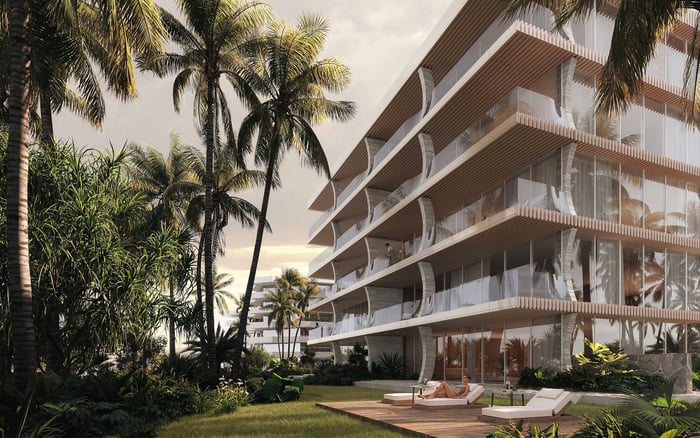
Glass House Boca Raton’s $70 million construction financing is documented. Litigation concerns, insurance-renewal negotiations, and any related lender response remain diligence questions, not established events. A private-client framework for separating the financing milestone from the documents a purchaser should review.

For a purchaser considering Glass House Boca Raton, the essential distinction is between a documented financing milestone and questions that require transaction-specific diligence. A $70 million construction loan was disclosed in March 2026. The project information summarized here does not establish a specific pending lawsuit, an insurance-renewal negotiation, or an adverse lender reaction tied to either issue.
Those subjects belong on a buyer’s diligence agenda, not in an account of established project events. Equally, the absence of such disclosures is not legal clearance or confirmation that no private dispute or insurance issue exists. For a substantial residential commitment, confidence should rest on the documents governing the purchase, construction, coverage, and eventual ownership.
The appropriate posture is neither alarm nor automatic reassurance. It is a disciplined review that separates what has been disclosed from what counsel, an insurance adviser, and the purchaser’s lender should independently establish.
Glass House is planned as a nine-story, 28-residence luxury condominium at 280 E. Palmetto Park Road in Downtown Boca Raton. Its developer is 280 E. Palmetto Park Road LLC, led by Noam Ziv. The development address should not be confused with the sales gallery at 221 E. Palmetto Park Road.
Construction had been identified as underway by June 2025. In March 2026, completion was projected for late 2027. That remains a forecast, not a guaranteed delivery date. A purchaser should reconcile it with the timing provisions in the purchase agreement.
Maxim Capital provided the $70 million construction loan to fund vertical construction. The financing also refinances existing early-work financing and is intended to support the project through completion. More than one-third of the residences had been presold at the time of the financing announcement-a historical snapshot, not a statement of current availability.
These facts establish a meaningful capital milestone. They do not establish every condition governing future funding, a fixed completion outcome, or the purchase’s suitability for a particular household.
The project information summarized here does not establish a specific pending lawsuit, judgment, construction-defect claim, or enforcement action. This briefing does not substitute for a court-record search.
A buyer should ask counsel to review Palm Beach County court records using the development entity and other relevant parties identified in the transaction documents. That review should sit alongside applicable condominium filings, offering documents and amendments, purchaser disclosures, and title materials.
The questions should be precise: Are any proceedings disclosed? Which entity is involved? What relief is sought? Could the matter affect title, construction obligations, delivery, or purchaser remedies? These are recommended inquiries, not assertions that such proceedings exist at Glass House.
For a household also considering Alina Residences Boca Raton, the same documentary discipline applies. The comparison should focus on the completeness and relevance of each purchase file, without implying that the developments share legal circumstances.
Request written responses and have counsel reconcile them with the contract and amendments. A broad verbal assurance cannot replace an answer tied to the correct entity, property, and review date.
The project information summarized here does not document Glass House insurance-renewal negotiations, carrier terms, premiums, deductibles, exclusions, limits, or a delayed or conditioned renewal. A renewal dispute or coverage restriction therefore should not be presented as a project fact.
The next step is to request insurance certificates and available builder’s-risk and liability policies for professional review. Ask the insurance adviser to identify the insured entities, covered interests, policy periods, limits, deductibles, exclusions, and relevant endorsements. Seek clarification of any renewal dates or coverage transitions within the anticipated construction period.
If renewal discussions are identified in the transaction file, ask for their status and any written terms available for review. Distinguish a proposal from bound coverage, and an unresolved question from a confirmed restriction. A closed construction loan is no basis for assuming either favorable or unfavorable insurance terms.
For a purchaser comparing The Residences at Mandarin Oriental Boca Raton, the same questions can structure an independent insurance review. Neither a residential name nor a financing announcement should replace examination of the coverage applicable to the property being purchased.
The documented lender action is the $70 million construction financing. The project information summarized here does not establish that litigation or insurance concerns prompted lender objections, additional protections, or a change in appetite. Calling the loan a reaction to either issue would go beyond the established facts.
The disclosed terms do not include the interest rate, loan-to-cost ratio, covenants, completion guarantees, presale-release provisions, or detailed collateral package. A buyer should not infer those provisions from the size of the commitment.
Where available, request relevant lender terms and ask counsel which provisions bear on the purchaser’s position. If loan documents are unavailable to the buyer, focus on the protections and obligations in the purchase agreement and related disclosures. Do not assume that lender protections extend to the purchaser.
Keep the two financing decisions separate. Developer construction financing is not evidence that an individual buyer’s mortgage has been approved. A purchaser intending to borrow should seek a separate assessment from their own lender before treating financing as settled.
A 28-residence plan gives the purchase a clearly defined scale, but it does not establish future ownership costs. Review the projected condominium budget alongside insurance information, and ask which assumptions remain estimates. An attractive initial budget is no substitute for reviewing the obligations in the governing documents.
The core file should bring together litigation disclosures, title materials, offering documents and amendments, permits, construction contracts where available, relevant lender terms, insurance documentation, and the projected budget. Counsel should compare the late-2027 completion forecast with contractual delivery provisions, extension rights, and purchaser remedies.
The objective is a coherent decision: what is documented, what remains unresolved, and which unanswered questions matter before the next contractual commitment. Glass House’s construction financing is a substantive milestone. It is neither evidence of undisclosed distress nor a substitute for purchaser diligence.
For a discreet conversation about Boca Raton residences and a document-led purchase strategy, connect with MILLION.
If branded residences are on your mind — as a home or as an allocation — we would be glad to share what we are seeing, privately.
Begin a quiet conversationThe development is at 280 E. Palmetto Park Road in Downtown Boca Raton. Its sales gallery is separately located at 221 E. Palmetto Park Road.
Glass House Boca Raton is planned as a nine-story luxury condominium with 28 residences.
The developer is 280 E. Palmetto Park Road LLC, led by Noam Ziv.
A $70 million construction loan from Maxim Capital was disclosed in March 2026. It funds vertical construction, refinances early-work financing, and is intended to support the project through completion.
The completion forecast disclosed in March 2026 was late 2027. It is not a guaranteed delivery date and should be compared with the purchase agreement.
The project information summarized here does not establish a specific pending lawsuit, judgment, construction-defect claim, or enforcement action. That does not substitute for a court-record search or establish that no dispute exists.
The project information summarized here does not document renewal negotiations, carrier terms, or a delayed or conditioned renewal. Buyers should request coverage documents and have an insurance adviser review them.
The established lender action is the construction financing. The information summarized here does not establish that litigation or insurance concerns prompted objections or special protections.
No; developer construction financing is distinct from an individual purchaser’s mortgage, which requires a separate assessment by the purchaser’s lender.
Request litigation disclosures, offering documents and amendments, title materials, permits, construction contracts where available, relevant lender terms, insurance documentation, and the projected condominium budget. Counsel should review these alongside the purchase agreement.