House of Wellness Brickell advertises a rooftop clubhouse with an event kitchen, but ownership planning requires a closer look at reservation rights, outside-caterer access, and approved guest capacities. Here is what buyers should establish before treating those spaces as an extension of home.
For a buyer who entertains, the most valuable amenity is not simply a beautiful room. It is one that can be secured for the right evening, with the right guests and a clear service arrangement. At House of Wellness Brickell, the planned rooftop clubhouse with an event kitchen presents an appealing possibility. It does not, by itself, establish a private-dining entitlement.
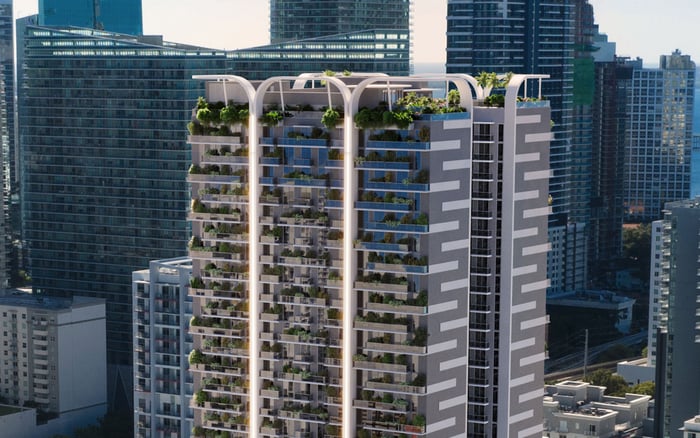
The project is marketed as a pre-construction residential condominium at 152 SW 9th Street, Miami, FL 33130. Plans describe a 34-story tower with approximately 656 residences and a wellness-focused concept. For ownership purposes, the distinction is straightforward: advertised entertaining spaces are not the same as confirmed booking rights, catering permissions, or approved guest counts.
The assessment must therefore remain conditional. The offering includes planned resident entertaining amenities, but the operating rules that would make them dependable for private occasions remain unverified. That does not mean events are prohibited or policies do not exist. Buyers should obtain written terms before relying on a particular use.
The rooftop clubhouse and event kitchen are the clearest advertised features relevant to hosted dining. Grills and outdoor lounge areas offer potential social settings, while a social lounge, juice bar, and pantry broaden the communal amenity program. Co-working spaces and a podcast room are also listed, but neither establishes additional event space.
These distinctions matter. A pantry does not establish staffed food service. An event kitchen does not confirm a full-service private restaurant, banquet operation, or managed catering program. Nor does outdoor seating establish that a resident can reserve it exclusively alongside the clubhouse.
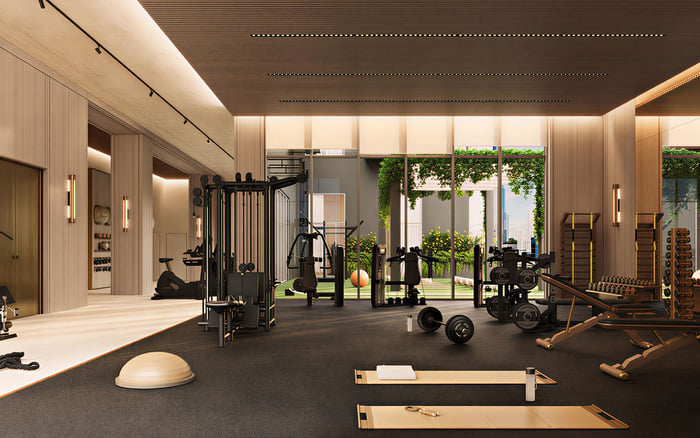
More than 22,000 square feet of dedicated wellness space is advertised. That figure describes the wellness offering-not the private-dining footprint or an approved event capacity. It should not be used to estimate how many people an owner could invite.
The first question is whether the clubhouse can be reserved exclusively at all. The advertised description does not establish exclusive-use rights, management-controlled reservations, or first-come access. It also provides no formal private-dining booking policy, reservation calendar, or rental-fee schedule.
A buyer should request the proposed or current amenity-use policy and seek written answers covering:
Eligibility to reserve, including whether the owner must attend.
Booking windows, priority rules, and limits on reservation frequency.
Permitted hours, setup time, breakdown time, and noise restrictions.
Rental charges, deposits, cancellation terms, and cleanup obligations.
These details determine whether the room works for a carefully planned dinner rather than an informal gathering. A reservation window has limited practical value if setup and cleanup consume most of it. Exclusivity also needs a precise definition: ask whether other residents retain access to adjoining lounges or outdoor areas during a booking.
For buyers also considering 2200 Brickell, the useful comparison is between written reservation terms for the spaces they expect to use-not between amenity names. A shared neighborhood or marketing vocabulary does not establish shared operating rules.
An advertised event kitchen does not confirm permission for outside caterers or private chefs. The disclosed amenity description does not establish approved vendors, equipment specifications, loading procedures, or vendor-insurance requirements.
Begin with the intended meal. Ask whether the kitchen permits cooking, reheating, plating, or only serving food prepared elsewhere. Obtain an equipment schedule rather than assuming the event kitchen provides the appliances, refrigeration, work surfaces, or storage a chosen chef requires.
Then trace the service route. Where would deliveries arrive? Could a caterer use a freight elevator, and during which hours? Would security require advance vendor registration? What insurance documentation would be necessary? These are questions to resolve, not restrictions to presume.
Alcohol service warrants separate written clarification, as do waste removal and post-event cleaning. Ask who is responsible for each task and whether any staff must be engaged. The absence of a published fee schedule is not confirmation that hosting is complimentary.
The same discipline applies if Cipriani Residences Brickell is on a buyer's shortlist: evaluate the actual service arrangement rather than importing expectations from a name. At House of Wellness Brickell, the event-kitchen designation alone cannot answer these operational questions.
The advertised description establishes no numerical clubhouse occupancy, event-kitchen capacity, guest limit, or resident-to-guest ratio. Assigning a plausible dinner-party size would create false precision.
Request approved capacities for the intended arrangement, distinguishing seated dining from a standing reception if the applicable documents make that distinction. Ask whether the total includes hosts, children, caterers, and other service personnel. A useful answer should identify both the relevant space and the event configuration.
Establish, too, whether the clubhouse, kitchen, and outdoor areas may be reserved together. Do not add the apparent capacities of separate amenities and treat the result as an allowable guest count. Confirm whether simultaneous use is permitted and whether access routes or shared areas must remain available to other residents.
If outdoor entertaining is central to the plan, ask what happens when weather moves guests indoors. An outdoor reservation should not be treated as a guarantee of an indoor alternative.
The property is marketed as approximately a four-minute walk from Brickell City Centre. Nearby dining may appeal to an owner who prefers to entertain away from home, but it remains outside the building's own amenity program. Proximity does not establish restaurant booking privileges or building-arranged catering.
For someone comparing The Residences at 1428 Brickell with House of Wellness Brickell, the practical exercise begins with the desired occasion: who attends, what is served, which spaces are needed, and how much privacy matters. Test each property's documented terms against that brief, without assuming identical offerings.
Request the latest declaration, bylaws, rules and regulations, amenity-use policy, and developer disclosures. Have the relevant provisions reviewed alongside written responses addressing the intended event. If hosting is essential to the purchase decision, clarify which terms are proposed and which are established in the governing documents.
The ownership conclusion is measured: a planned rooftop clubhouse with an event kitchen and social spaces offers an appealing entertaining concept, but booking, catering access, and event-size rules require confirmation. Value the amenity for what is documented, not for the dinner party one can imagine inside it.
For a considered approach to Brickell ownership and amenity due diligence, connect with MILLION.
If branded residences are on your mind — as a home or as an allocation — we would be glad to share what we are seeing, privately.
Begin a quiet conversationIt is marketed as a pre-construction condominium at 152 SW 9th Street, Miami, FL 33130, in Brickell.
Plans describe a 34-story tower with approximately 656 residences and a wellness-focused concept.
A planned rooftop clubhouse with an event kitchen is the clearest advertised entertaining amenity. Grills, outdoor lounge areas, a social lounge, a juice bar, and a pantry are also listed.
Exclusive-use rights are not established in the advertised description. Buyers should obtain written confirmation of reservation eligibility and the scope of any private booking.
The advertised description does not provide a rental-fee schedule or formal booking policy. Ask about charges, deposits, cancellation terms, and cleanup obligations.
Their access remains unverified. An event kitchen alone does not establish permission for outside vendors or private chefs.
Request equipment specifications and permitted food-preparation activities, along with delivery, loading, elevator, security, and vendor-insurance requirements.
No numerical clubhouse occupancy, event-kitchen capacity, guest limit, or resident-to-guest ratio is established. Obtain written capacity confirmation for the intended space and layout.
No. The advertised figure of more than 22,000 square feet concerns dedicated wellness space, not private-dining area or approved guest capacity.
Request the latest declaration, bylaws, rules and regulations, amenity-use policy, and developer disclosures. Review them alongside written answers about the intended hosting arrangement.